


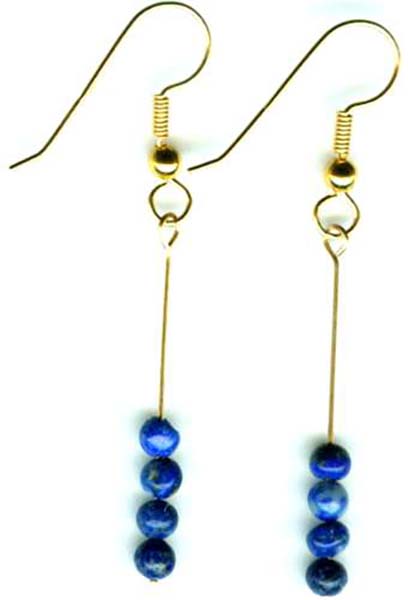
Genuine, Natural, High Quality Antique Hand Crafted Afghani Produced Semi-Precious Blue Lapis Lazuli Gemstones on 14kt Gold Fill French Hooks (not cheap gold electroplate).
Eight handcrafted antique lapis lazuli 4mm round gemstones, approximately two and one-half carats total gemstone weight. Mounted onto high quality 14kt gold fill french hooks.
NOTE: Other setting styles (studs, lever backs, euro clicks, kidney wires, ball/stud dangles, fancy dangles, etc., are available upon request both in 14kt gold fill as well as 14kt solid gold.
DETAIL: Popular with the ancient Israelites, lapis is generally acknowledged by Biblical scholars to be one of the breastplate stones of the High Priest, representing one of the twelve tribes of ancient Israel. To the ancient Hebrews, lapis lazuli was the symbol of success, capturing the blue of the heavens and combining it with the glitter of gold in the sun. It was also believed by the ancient Hebrews that the tablets upon which Moses received the Ten Commandments were of lapis lazuli. In nearby ancient Egypt, lapis lazuli was associated with the ancient Egyptian Goddess “Hathor”, goddess of love, music, and beauty, who was often referred to as "the lady of lapis lazuli." There’s also some evidence that ancient Egyptian judges wore carved lapis amulets of Ma'at, the Goddess of truth, balance and order.
Celebrating our historical legacy here's a gorgeous p[air of earrings featuring richly colored natural dark blue lapis lazuli semi-precious gemstones from the 7,000 year old mines at Badakhshan in Afghanistan, source of lapis lazuli for the ancient Egyptians, Sumerians, Phoenicians, and the rest of the ancient world. These gemstones were hand shaped, hand polished, and hand drilled in early 20th century, one of the principal gemstone finishing centers in the world. Originally produced for use in indigenous jewelry, brightly colored lapis lazuli necklaces and bracelets are extremely popular in Russia. The diminutive gemstones are exquisitely colored a mottled dark blue, considerably lighter than inky "midnight blue" African or Australian sapphires, but well past the medium blue of sapphires from Ceylon and Burma. It is truly a very rich and regal blue, bringing to mind all of the rich pageantry of the royal houses of Europe.
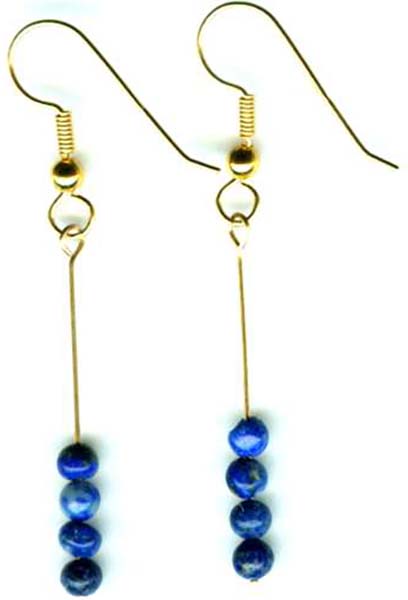
The earring settings are of contemporary origin. They are high quality settings manufactured by one of the USA’s leading semi-custom mount producers. They are constructed of 14kt gold fill. Not to be confused with the cheap gold electroplate jewelry from Asia so widely sold in the USA and Europe (oftentimes misrepresented as "solid gold"). These are high-quality earrings made right here in the USA. 14kt "Gold Fill" is a process which creates a solid gold sandwich constructed of 5% solid gold over a base metal core such as sterling silver. It is not merely an electroplate few thousandths of a millimeter of gold barely covering a base metal. This is a permanent, high quality bond which you will never wear through. Gold Fill jewelry has a gold layer 100 times thicker than merely electroplating. It is considered permanent jewelry, not costume jewelry. We can reset into 14kt solid gold upon request, and there are also many other setting styles available upon request including euro clicks, lever backs, kidney wires, ball/stud dangles, etc.
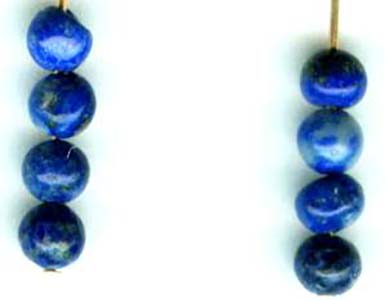
As might be expected under magnification the gemstones show the unmistakable characteristics of having been hand crafted. The coarseness of the handcrafted finish is considered appealing to most gemstone collectors, and is not considered a detriment, or detract from the value of a gemstone. Naturally these characteristics are not only expected of hand-finished gemstones, most serious collectors consider such gemstones more desirable, possessed of greater character and uniqueness when compared to today's cookie-cutter mass-produced machine-tumbled gemstones. Unlike today’s computer controlled machine produced gemstones, the cut and finish of gemstones such as these is the legacy of a artisanal heritage passed forward from centuries past. Such hand-crafted gemstones possess much greater character and appeal than today's mass-produced machine-cut gemstones.
LAPIS LAZULI HISTORY: Most lapis lazuli contains iron pyrite in the form of golden flecks sprinkled throughout the gemstone, the hallmark characteristic of lapis lazuli, often compared by ancient populations with stars in the sky. Lapis Lazuli was among the treasures of ancient Mesopotamia, Byzantium, Egypt, Persia, Greece and Rome. Lapis Lazuli gets its name from the Arabic word "allazward", meaning "sky-blue". Along with turquoise and carnelian, the three are undoubtedly amongst the most ancient of gemstones. For more than 7,000 years lapis lazuli has been mined as a gemstone in Afghanistan, near ancient Mesopotamia, and traded throughout the ancient Mediterranean world.
The ancient source of lapis lazuli was these very same mines at Badakhshan (also known as the “Hindu-Kush” mountains), in the Persian highlands above the fertile Mesopotamian lowlands. The Persian highlands and plateau provided many of the raw materials lacking in the ancient civilizations abounding in the Mesopotamian lowlands (the "fertile crescent"). Records indicate that the Sumerian city of Ur imported lapis lazuli from the mines at Badakhshan as early as 4,000 B.C. In fact, the ancient royal Sumerian tombs of Ur, located near the Euphrates River in lower Iraq, contained more than 6,000 beautifully executed lapis lazuli statuettes of birds, deer, and rodents as well as dishes, beads, and cylinder seals.
Most ancient jewelry typically used one or more of three gemstones (carnelian, turquoise), and lapis lazuli was certainly very popular. How popular? One of the richest examples of ancient jewelry is Queen Pu-abi's tomb at Ur in Sumeria dating from the 3rd millennium B.C. In the crypt the queen was covered with a robe of gold, silver, lapis lazuli, carnelian, agate, and chalcedony beads. The lower edge of the robe was decorated with a fringed border of small gold, carnelian, and lapis lazuli cylinders. Near her right arm were three long gold pins with lapis lazuli heads, and three amulets in the shape of fish. Two of the fish amulets were made of gold and the third, you guessed it, lapis lazuli. On the queen's head were three diadems each featuring lapis lazuli.
At roughly the same point in time as Queen Pu-abi’s reign in Ur, lapis lazuli was also certainly popular in 3,100 B.C. with the Egyptians who used it in medicines, pigments (ultramarine), cosmetics (eye-shadow), carved into seals, and of course, in jewelry. The famous mask covering the head of Tutankhamen's mummy is inlaid primarily in lapis lazuli, with accents of turquoise and carnelian. In both the tombs of Tutankhamen and Queen Pu-abi, two of the richest tombs in all history, lapis lazuli was featured prominently in both. Called the "stone of rulers," in ancient kingdoms like Sumer and Egypt, lapis was forbidden to commoners, worn only by royalty. Ancient Egyptians believed lapis lazuli to be sacred and used it in the tombs and coffins of pharaohs.
Much of the lapis lazuli which flowed through the ancient land of Bactria and into Ur was exported to Egypt, where it was known as “khesbed”, which translates to “joy and delight”. In ancient Egypt lapis lazuli was widely used as a talisman believed to provide its wearers with good luck and ward off evil spirits and injury. Lapis lazuli was also thought to possess life-giving powers in ancient Egypt. Lapis was used to produce amulets to protect the mummified remains of pharaoh and commoner alike. It was a common practice to place a lapis amulet, engraved with a chapter of the Book of the Dead, over the area where the heart had been removed from the mummified remains (the heart was believed to be the repository of the soul), prior to the sealing of the sarcophagus.
Archaeological discoveries also have made it abundantly clear that coupled with gold, lapis lazuli was valued simply for its beauty as jewelry. Lapis lazuli was also associated with the ancient Egyptian Goddess “Hathor”, goddess of love, music, and beauty, who was often referred to as "the lady of lapis lazuli." Lapis was also associated with both the night sky and the rising run, which was sometimes referred to as the "child of lapis lazuli." The stone was also associated with the primordial waters of the ancient Egyptian creation myth. The Nile was rendered in blue color on grave paintings, blue thought to represent fertility. Lapis lazuli hippopotamuses produced by ancient Egyptian artisans were popular as symbols for the life-giving river.
There’s also some evidence that ancient Egyptian judges wore carved lapis amulets of Ma'at, the Goddess of truth, balance and order. These concepts were fundamental to Egyptian life and the rule of the Pharaohs, who portrayed themselves constantly as "Beloved of Ma'at" and "upholders of the universal order". Ancient Egyptian hieroglyphs also described medicinal uses for lapis lazuli, including its use powdered, mixed with milk and mud from the Nile as a treatment for cataracts as well as head pains. And of course the ancient Egyptians made wide use of lapis lazuli as eye shadow. In fact, historians document its use as eye shadow by Cleopatra, last of the Ptolemaic rulers of Ancient Egypt.
Popular with another Middle Eastern people, the Israelites, lapis is generally acknowledged by Biblical scholars to be one of the breastplate stones of the High Priest. To the ancient Hebrews, lapis lazuli was the symbol of success, capturing the blue of the heavens and combining it with the glitter of gold in the sun. It was also believed by the ancient Hebrews that the tablets upon which Moses received the Ten Commandments were of lapis lazuli. Lapis lazuli was also used by the ancient Assyrians and Babylonians for cylinder seals. According to one ancient Persian legend, the heavens reflected their blue color from a massive slab of lapis upon which the earth rested. Throughout the history of the Ancient Middle East, lapis lazuli has often been regarded a sacred stone and to possess magical powers.The first century Roman historian and naturalist Pliny the Elder accurately described lapis lazuli, though the ancient Romans referred to it as “sapphirus”. The Romans also used lapis lazuli as an aphrodisiac, and associated lapis lazuli with the lord of Gods of the Roman pantheon, “Jupiter” (“Zeus” to the ancient Greeks). Lapis lazuli was also accurately described by Theophrastos, the fourth century B.C. Greek philosopher and naturalist. In addition to its use in jewelry, lapis lazuli has also been used since ancient times for mosaics and other inlaid work, carved amulets, vases, and other objects. In antiquity, as well as in the Middle Ages, there was the belief that the cosmos was reflected in gemstones. Lapis lazuli was associated with the planet Jupiter.
In the medieval world lapis was ground and used as a pigment as well as for medicinal purposes. For medicinal applications, the powdered lapis lazuli was mixed with milk and used as a compress to relieve ulcers and boils. Lapis Lazuli and the mines at Badakhshan were described by Marco Polo in 1271 A.D., though the first written accounts of the mines had been produced three centuries earlier, in the tenth century A.D., by the Arab historian Istakhri. When lapis was first introduced to Europe, it was called "ultramarinum", which means "beyond the sea". It was identified as an emblem of chastity, and was thought to confer ability, success, divine favor, and ancient wisdom.
According to the 17th century “Complete Chemical Dispensatory”, lapis lazuli was effective as a cure for sore throat, used to combat melancholy, and a cure for “apoplexies, epilepsies, diseases of the spleen, and many forms of dementia”. The text also indicated that it could be worn about the neck as an amulet to drive away frights from children (timid children were given necklaces of lapis beads in the belief that they would develop courage and fearlessness) to strengthen sight, prevent fainting, and also to prevent miscarriages. Wearing an amulet made of lapis was also thought to free the soul from error, envy and fear as well as protect the wearer from evil. Ground lapis was also the secret of the blue in ultramarine, the pigment which painters used to paint the sea and the sky until the nineteenth century.
Used as a pigment most extensively in the fourteenth and fifteenth centuries, the secret behind some of the most beautiful Renaissance-inspired paintings was ground lapis lazuli. In no small part due to the tremendous demand for lapis to produce ultramarine, the cost of lapis was exorbitant in Renaissance Europe. A price list of gems in the eighteenth century, using the emerald as the unit of value, ranked sapphire as twice the value of emerald, ruby as thrice the value, and lapis as fifteen times the cost of emerald. Lapis was also popular in inlays. In what was once one of the cultural capitals of Europe, the columns of St. Isaac's Cathedral in St Petersburg, Russia are lined with lapis (see here, here, and here ), and the Pushkin Palace has forty foot tall lapis lazuli paneling (see here, here, and here)! Though most of the lapis used in Russia’s landmark architecture was again, from Afghanistan, lapis lazuli was eventually discovered at Russia’s Lake Baikal, as well as in the Pamir Mountains of Central Asia (see here and here).
In the ancient history of Mesoamerica, an inferior grade of lapis lazuli was mined in Northern Chile for over 1,000 years by the Moche, a culture from the coast of Northern Peru (200 B.C. to 800 A.D.), who were skilled metalworkers, producing ornaments made of gold, silver, and lapis lazuli. Their traditions were carried forward by their successors the Chimu for another 600 years, the Chimu in turn ultimately absorbed by the Incas. Throughout the history of the ancient world, gemstones were believed capable of curing illness, possessed of valuable metaphysical properties, and to provide protection. Found in Egypt dated 1500 B. C., the "Papyrus Ebers" offered one of most complete therapeutic manuscripts containing prescriptions using gemstones and minerals.


Gemstones were not only valued for their medicinal and protective properties, but also for educational and spiritual enhancement. In the ancient world it was believed that ground lapis lazuli consumed as a supplement bolstered skeletal strength and thyroid function. It was also believed to improve sleep, cure insomnia, and was used to treat varicose veins. On the metaphysical plane, lapis lazuli was believed to enhance ones awareness, creativity, extra-sensory perception, and expand ones viewpoint, while keeping the spirit free from the negative emotions of fear and jealousy. Even today lapis lazuli is regarded by many cultures around the world as the stone of friendship and truth. The blue stone is said to encourage harmony in relationships and help its wearer to be authentic and give his or her opinion openly.
HISTORY OF GOLD: From the earliest of times, gold was often held in awe as the symbol of divinity and was therefore the material of choice for religious objects. Gold was among the first metals to be mined because it commonly occurs in pure form (not combined with other elements), because it is beautiful and imperishable, and because exquisite objects can be made from it. Since gold is found uncombined in nature, early goldsmiths would collect small nuggets of gold from stream beds etc., and then weld them together by hammering. It was oftentimes discovered alloyed with 10%-20% silver, the mixture known as “electrum”. Gold was "discovered" well before 6,000 B.C., most likely in Mesopotamia, though some of the oldest gold objects made by mankind were discovered by archaeologists in present-day Bulgaria (ancient Thrace) and in the Balkans, such as at the Varna Necropolis.
In ancient Egypt all gold was the property of the pharaoh. Artifacts and jewelry of gold over 5,000 years old have been uncovered by archaeologists in Egyptian tombs. Around 3,600 B.C. Egyptian goldsmiths carried out the first smelting of ores using blowpipes made from fire-resistant clay to heat the smelting furnace. Ancient Egyptian hieroglyphs describe gold as the brilliance of the sun. In the Near East, by 2,500 B.C., Sumerian goldsmiths were using sophisticated metalworking techniques; cold hammering, casting, soldering, cloisonné, and particularly filigree (fine-wire ornamentation) and granulation (the use of minute drops of gold). The tomb of the Sumerian Queen Puabi, from the city of Ur in about the 26th century B.C., was one of the richest tombs ever uncovered by archaeologists.
Queen Puabi was buried with five soldiers and thirteen "ladies in waiting" who had apparently poisoned themselves (or been poisoned) to serve their mistress in the next world. The grave goods she was buried with included a magnificent, heavy, gold headdress made of golden leaves, rings, and plates; a superb lyre complete with a gold and lapis-lazuli encrusted bearded bulls head; a profusion of gold tablewear; cylindrical beads of gold, carnelian, and lapis lazuli woven into extravagant necklaces and belts; a chariot adorned with lioness' heads in silver, and an abundance of silver, lapis lazuli, and gold rings and bracelets.
Another of the most famous tombs uncovered by archaeologists was that of 14th century B.C. Tutankhamun. The pharaohs of Egypt insisted on being buried in gold, which they believed was the "flesh of the gods." The boy-king Tutankhamun was enshrined in three gold coffins. The third and final coffin was made of 243 pounds (110 kilograms) of solid gold. As well, gold artifacts and jewelry abounded, including the solid gold mask which weighed 10 kilos (24 pounds). It’s worth noting that Tutankhamun was a minor, almost unknown and forgotten pharaoh. One can only imagine the wealth of gold some of ancient Egypt’s more significant pharaohs (such as Ramses the Great) must have been buried with.
The art of fashioning gold jewelry reached the Mediterranean island of Crete (the ancient Minoans) about 2400 B.C. Diadems, hair ornaments, beads, bracelets, and complex chains have been found in Minoan tombs. Near Eastern techniques of filigree and granulation were introduced to Crete about 2000 B.C., and evidence also indicates that Egyptian styles influenced Minoan jewelry. Minoan culture and its jewelry styles spread to the mainland of Greece, then dominated by the city-state of Mycenea, about 1550 B.C. The graves of nobles at the ancient Citadel of Mycenae discovered by Heinrich Schliemann in 1876 likewise yielded a great variety of gold figurines, masks, cups, diadems, and jewelry, plus hundreds of decorated beads and buttons. These elegant works of art were created by skilled craftsmen more than 3,500 years ago.
Metalworking techniques reached northern Europe by about 2000 B.C., and the earliest jewelry found there dates from between 1800 and 1400 B.C. These artifacts include lunulae (spectacular, crescent-shaped neck ornaments of beaten gold), most of which were found in graves in Ireland, where gold was once plentiful. There is evidence that the Celtic and early British people were trading with the Eastern Mediterranean races by this time, exchanging gold for faience beads. By 1200 B.C. jewelry making was flourishing in Central and Western Europe, where bronze as well as gold was frequently used to make jewelry, and the spiral was the most common motif of decoration. The fibula-brooch seems to have been invented at about this time.
Twisted gold torcs, modeled on Scandinavian bronze prototypes, were made in the British Isles and northern France from the fifth to the first century B.C. These massive circlets for the necks and arms were the characteristic ornaments of the chiefs of the Celtic race, and were symbols of wealth, power and courage across Celtic Europe. Celtic craftsmen also used enamel and inlay to decorate jewelry. By the seventh century B.C. the Etruscans of Central Italy were also making fine gold jewelry. These people may have migrated from Anatolia (present-day Turkey), from where their metalworking skills seem to have been derived. The Etruscans brought to perfection the difficult technique of granulation, whereby the surface of the metal is covered with tiny gold grains.
Gold was plentiful in Greece during the Hellenistic Age (323-30 B.C.), and Greek jewelry of this period is characterized by its great variety of forms and fine workmanship. Naturalistic wreaths and diadems were made for the head, and a variety of miniature human, animal, and plant forms were made up into necklaces and earrings. The so-called Heracles-knot, of amuletic origin, was introduced, and remained a popular motif into Roman times. The ancient Mediterranean civilizations appear to have obtained most their supplies of gold from various deposits in the Middle East, as well as gold which came through the Middle East from Southern Africa, and perhaps a minor amount from the Ural Mountains of present-day Russia.
Mines in the region of the Upper Nile (south of Egypt) near the Red Sea and in the Nubian Desert area supplied much of the gold used by the Egyptian Pharaohs (the area was known to the ancient Egyptians as “Punt”, and to the ancient Christians as “Sheba” or “Saba”). When these mines could no longer meet Egypt’s demand for gold, deposits elsewhere were exploited, likely including deposits thousands of miles away in Southern Africa. Archaeological evidence indicates that most of the gold in Ancient Egypt and even in the ancient Mediterranean from perhaps 1700 B.C. onwards came from the Himyarites in present-day Yemen (across the Red Sea from Nubia), who in addition to exploiting their own deposits, may in turn have obtained much of the gold they exported to the ancient Egyptians from present day Rhodesia/Zimbabwe.
In fact the Himyarites likely controlled most of the east coast of Africa, including Rhodesia/Zimbabwe, and is most likely the area referred to as Monomotapa in ancient texts (known also as the Biblical city of Ophir, from which the Bible records that King Solomon received shipments of gold, silver, ivory, gemstones, and peacocks). Artisans in Mesopotamia and Palestine probably obtained their supplies either directly from the Himyarites or indirectly through (middleman) Egypt. As well, recent studies of the ancient mines in the present Kingdom of Saudi Arabia (directly to the north of Yemen) reveal that gold, silver, and copper were recovered from the Red Sea region, across the Red Sea from the Nubian deposits, during the reign of King Solomon (961-922 B.C.).
Around 1500 B.C. artisans of the ancient world developed the “lost wax” method of producing jewelry, allowing for the “mass production” of gold jewelry. At the same time, gold had already become the recognized medium of exchange for international trade. The sixth century B.C. saw the first use of gold in dentistry by the ancient Egyptians, and the introduction of the first gold coinage in Asia Minor by King Croesus of Lydia. By this time, much of the gold in the Classical Mediterranean cultures came from Spain, where extensive deposits of gold and silver were mined and then acquired by the ancient Phoenicians in trade, and then brought from the Western Mediterranean and traded through the ancient Mediterranean world.
Eventually the Phoenician colony of Carthage became the leading power of the Eastern Mediterranean, and gained control over these valuable Spanish deposits. In turn the Carthaginians engaged the Romans in three wars before Spain was lost to the Romans. Spanish gold and silver to a great extent allowed the Romans to expand their empire. The “other” great power of the Classical Mediterranean were the Hellenic Greeks, who by 325 B.C. were mining gold from Gibraltar to Asia Minor. When the gold in Spain began to play out, the Romans turned their attention toward the gold mines in Dacia (modern Romania). The Dacians had historically traded this gold to the Greeks for pottery and to the Scythians for amber. About 100 A.D. the Roman Emperor Trajan conquered Dacia, mainly in order to gain control of these gold mines.
The Romans also exploited smaller gold deposits found in the British Isles. The Romans used very sophisticated extraction and mining techniques as detailed by the first-century historian and naturalist Pliny the Elder. The Romans were also the first to mass-produce coinage on a monumental scale, the first truly monetized society. Between the second and fourth centuries A.D., the Romans produced millions of gold aureus coins, and billions of silver and bronze coins. At the height of the Roman Empire, there were over 400 mints producing coinage in locations scattered through their dominion. Gold was fashioned into Greek style jewelry during the early Roman Empire, when the chief centers of production were Alexandria, Antioch, and Rome, to which Greek craftsmen had migrated.
There was an increasing emphasis in producing gold jewelry on incorporating decorative stones; at first garnets, chalcedonies, and carnelians, but later uncut but polished hard gemstones such as diamonds, sapphires, and, notably, emeralds from “Cleopatra’s Mines” in Egypt. Colorful gemstone jewelry was common during the Early Middle Ages in the centuries immediately following the collapse of the Roman Empire. Mediterranean goldsmiths continued to produce jewelry of great refinement, but the jewelry of the European Celtic tribes dominated this period. They produced abstract styles of great splendor which were worked in enamels and inlaid stones. The fibula-brooch reached extremes of size and elaboration. During the High Middle Ages the technique of cloisonné enameling on gold was widespread, the finest pieces emanating from the workshops at Constantinople, the capital of the Byzantine Empire.
After the creation of Charlemagne's empire in 800 A.D. and the Holy Roman Empire in 962 A.D., a fusion of northern and Mediterranean cultures occurred. The principal patrons of the arts became the emperor and the church, and jewelers worked in courts and monasteries. Jewelry design was based on the setting in gold of precious stones and pearls in colorful patterns. Gold was used widely for crosses, altars, doors, chalices, and reliquaries. This association with divinity naturally developed into an association with royalty. Even in modern times the accoutrements of royalty are predominantly gold. However there was a critical shortage of gold which developed in the High Middle Ages. During the years 1370-1420 A.D. as various major mines around Europe become completely exhausted. Mining and production of gold declined sharply throughout the region in a period known as 'The Great Bullion Famine'.
However by about 1433 A.D. this spurred the Portuguese to start sailing to Ghana in Western Africa and thus enabling them to trade for gold without having to cross the Sahara Desert into Muslim northern Africa. By 1471 A.D., the Portuguese were even calling West Africa the "Gold Coast", and a reliable source of gold was again available to Western Europe. In the “New World”, archaeologists believe that the gold in the Aztec and Inca treasuries of Mexico and Peru came from Colombia, although some undoubtedly was obtained from other sources. The Aztecs regarded gold as literally the product of the gods, calling it "god excrement". The Conquistadores plundered the treasuries of these civilizations during their explorations of the New World, and many gold and silver objects were melted and re-cast into coins and bars, destroying the priceless artifacts of these MesoAmerican cultures.
Gold is widely dispersed through the earth's crust (and even in seawater) and is found in two types of deposits; lode deposits, which are found in solid rock and are mined using conventional mining techniques, and placer deposits which are gravelly deposits found in stream beds and are the products of eroding lode deposits. The largest gold nugget ever found was in 19th century Australia weighing over 70 kilograms (150 pounds). Gold is quite unique in its malleability. No other metal compares with it. A single ounce can be stretched into a wire 60 kilometers long (40 miles), or pounded into a sheet of 300 square feet (the size of two typical suburban bedrooms).
Because of its chemical inertness, gold retains its brilliant color even after centuries of exposure to corrosive elements. The most workable of all metals, gold has been forged, chased, embossed, engraved, inlayed, cast, and in the form of gold leaf, used to gild metals, woods, leather, and parchment. Gold wire has found wide uses in brocades and ornamentation of other materials. Throughout at least five millennia of recorded history it has been used to fashion sculpture, vessels, jewelry, ornamentation, and coinage. Throughout the history of the ancient world, gemstones were believed capable of curing illness, possessed of valuable metaphysical properties, and to provide protection.
Found in Egypt dated 1500 B. C., the "Papyrus Ebers" offered one of most complete therapeutic manuscripts containing prescriptions using gemstones and minerals. Gemstones were not only valued for their medicinal and protective properties, but also for educational and spiritual enhancement. In the ancient world, gold was regarded to symbolize power, strength, wealth, warmth, happiness, love, hope, optimism, intelligence, perfection, summer, harvest and the sun. Gold was also believed to possess curative and “magical” properties. During justice, balance, the Middle Ages it was believed that something as rare and beautiful as gold could not be anything but healthy, so gold was regarded as beneficial for health and was not only worn but also ingested.
In fact, some gold salts do have anti-inflammatory properties, and in modern times, injectable gold has been proven to help to reduce the pain and swelling of rheumatoid arthritis and tuberculosis. The isotope gold-198 is also used in some cancer treatments and for treating other diseases. Gold flake was used by the nobility in Medieval Europe as a decoration in food and drinks, in the form of leaf, flakes or dust, either to demonstrate the host's wealth or in the belief that something that valuable and rare must be beneficial for one's health. Even today gold leaf, flake or dust is used on and in some gourmet foods, notably sweets (particularly in India and the Middle East) and drinks as decorative ingredient.
SHIPPING & RETURNS/REFUNDS: Your purchase will ordinarily be shipped within 48 hours of payment. We package as well as anyone in the business, with lots of protective padding and containers. All of our shipments are fully insured against loss, and our shipping rates include the cost of this coverage (through stamps.com, Shipsaver.com, the USPS, UPS, or Fed-Ex). Please be aware that postal rates are routinely hiked three times each year by the USPS, and have increased exponentially over the past decade. We set shipping rates as low as possible. However eBay charges steep commissions on shipping charges. And we have no control over the draconian rate increases the USPS levies multiple times every year (FOUR TIMES in the past 12 months as of April of 2026). International tracking is provided free by the USPS for almost all countries. Please note that with respect to international shipments, eBay/DHL shipping is typically less expensive than what the US Postal Service charges. But please be aware that DHL shipments generally offer very limited tracking, and inasmuch as shipments go to eBay first, then are consolidated before finally being transferred to DHL, they tend to be pretty slow.
ADDITIONAL PURCHASES do receive a VERY LARGE discount, typically about $5 per item so as to reward you for the economies of combined shipping/insurance costs. We do offer U.S. Postal Service Priority Mail, Registered Mail, and Express Mail for both international and domestic shipments, as well United Parcel Service (UPS) and Federal Express (Fed-Ex). Please ask for a rate quotation. Please note for international purchasers we will do everything we can to minimize your liability for VAT and/or duties. But we cannot assume any responsibility or liability for whatever taxes or duties may be levied on your purchase by the country of your residence. If you don’t like the tax and duty schemes your government imposes, please complain to them. We have no ability to influence or moderate your country’s tax/duty schemes.
If upon receipt of the item you are disappointed for any reason whatever, I offer a no questions asked 30-day return policy. Send it back, I will give you a complete refund of the purchase price; 1) less our original shipping/insurance costs, 2) less any non-refundable eBay fees. Please note that though they generally do, eBay may not always refund payment processing fees on returns beyond a 30-day purchase window. So except for shipping costs and any payment processing fees not refunded by eBay, we will refund all proceeds from the sale of a return item. Obviously we have no ability to influence, modify or waive eBay policies.
ABOUT US: Prior to our retirement we used to travel to Eastern Europe and Central Asia several times a year seeking antique gemstones and jewelry from the globe’s most prolific gemstone producing and cutting centers. Most of the items we offer came from acquisitions we made in Eastern Europe, India, and from the Levant (Eastern Mediterranean/Near East) during these years from various institutions and dealers. Much of what we generate on Etsy, Amazon and Ebay goes to support worthy institutions in Europe and Asia connected with Anthropology and Archaeology. Though we have a collection of ancient coins numbering in the tens of thousands, our primary interests are ancient/antique jewelry and gemstones, a reflection of our academic backgrounds.
Though perhaps difficult to find in the USA, in Eastern Europe and Central Asia antique gemstones are commonly dismounted from old, broken settings – the gold reused – the gemstones recut and reset. Before these gorgeous antique gemstones are recut, we try to acquire the best of them in their original, antique, hand-finished state – most of them originally crafted a century or more ago. We believe that the work created by these long-gone master artisans is worth protecting and preserving rather than destroying this heritage of antique gemstones by recutting the original work out of existence. That by preserving their work, in a sense, we are preserving their lives and the legacy they left for modern times. Far better to appreciate their craft than to destroy it with modern cutting.
Not everyone agrees – fully 95% or more of the antique gemstones which come into these marketplaces are recut, and the heritage of the past lost. But if you agree with us that the past is worth protecting, and that past lives and the produce of those lives still matters today, consider buying an antique, hand cut, natural gemstone rather than one of the mass-produced machine cut (often synthetic or “lab produced”) gemstones which dominate the market today. We can set most any antique gemstone you purchase from us in your choice of styles and metals ranging from rings to pendants to earrings and bracelets; in sterling silver, 14kt solid gold, and 14kt gold fill. When you purchase from us, you can count on quick shipping and careful, secure packaging. We would be happy to provide you with a certificate/guarantee of authenticity for any item you purchase from us. There is a $3 fee for mailing under separate cover. I will always respond to every inquiry whether via email or eBay message, so please feel free to write.