 |
|
The Price of War
British Policy on German
Reparations
1941-1949
by
Sir Alec Cairncross
|
|
 |
|
This is
the 1986 First Edition |
|
|
|
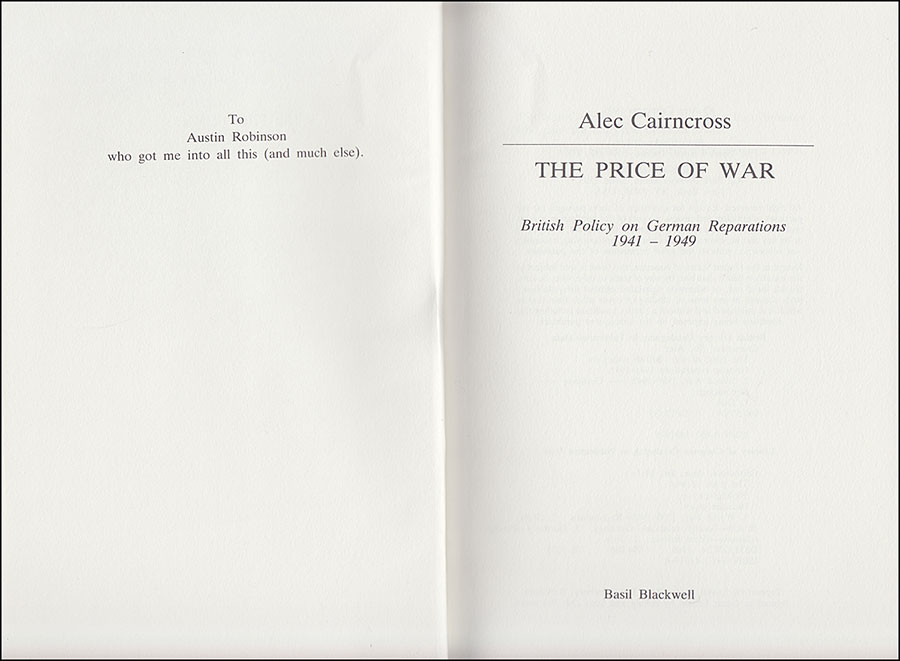
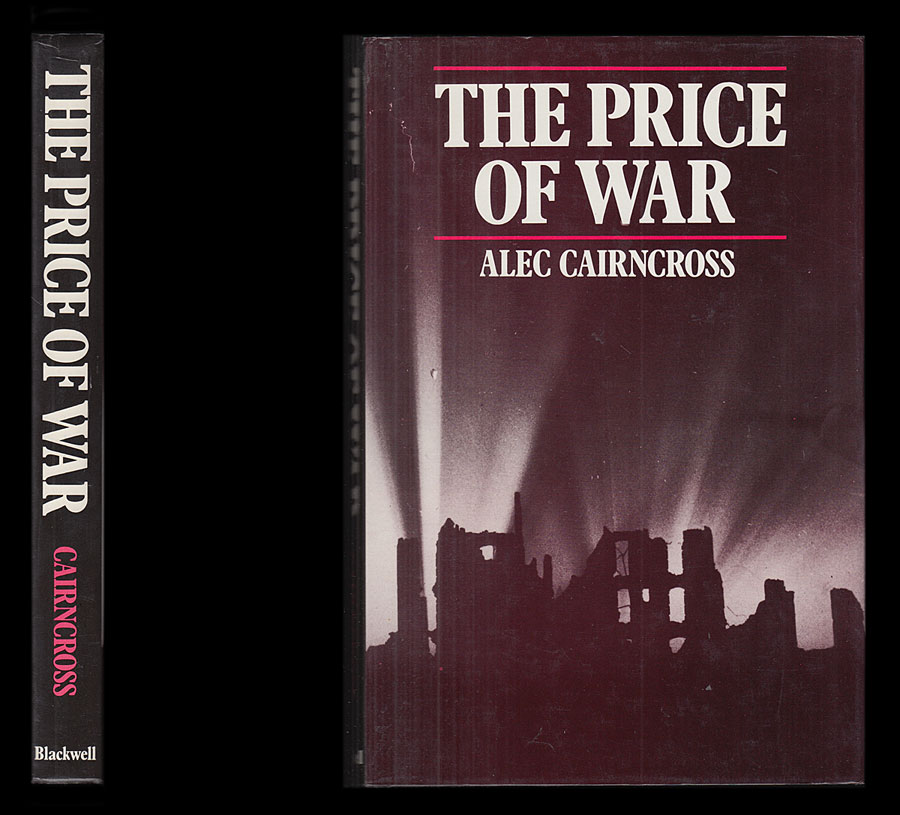
Front cover and spine
Further images of this book are
shown below
|
|
|
|
|
 |
|
|
|
|
|
Publisher and place of
publication |
|
Dimensions in inches (to
the nearest quarter-inch) |
|
London: Basil Blackwell |
|
6 inches wide x 9¼ inches tall |
| |
|
|
|
Edition |
|
Length |
|
1986 First Edition |
|
[x] + 249 pages |
| |
|
|
|
Condition of covers |
|
Internal condition |
|
Original black cloth blocked in silver on the
spine. The covers are rubbed and the spine ends and corners are bumped. |
|
The text is
very clean throughout. In Near Fine condition internally. |
| |
|
|
|
Dust-jacket present? |
|
Other
comments |
|
Yes: however, the dust-jacket is heavily scuffed
and
rubbed and is also creased around the edges. There is a small stain on the
inside bottom edge of the rear panel. |
|
This First Edition remains in Very Good
condition overall, but with a heavily scuffed dust-jacket. |
| |
|
|
|
Illustrations,
maps, etc |
|
Contents |
|
No illustrations are called
for |
|
Please see below for details |
| |
|
|
|
Post & shipping
information |
|
Payment options |
|
The packed weight is approximately
700 grams.
Full shipping/postage information is
provided in a panel
at the end of this listing.
 |
|
Payment options
:
-
UK buyers: cheque (in
GBP), debit card, credit card (Visa, MasterCard but
not Amex), PayPal
-
International buyers: credit card
(Visa, MasterCard but not Amex), PayPal
Full payment information is provided in a
panel at the end of this listing. |
|
|
|
|
|
 |
|
 |
|
|
|
The Price of War
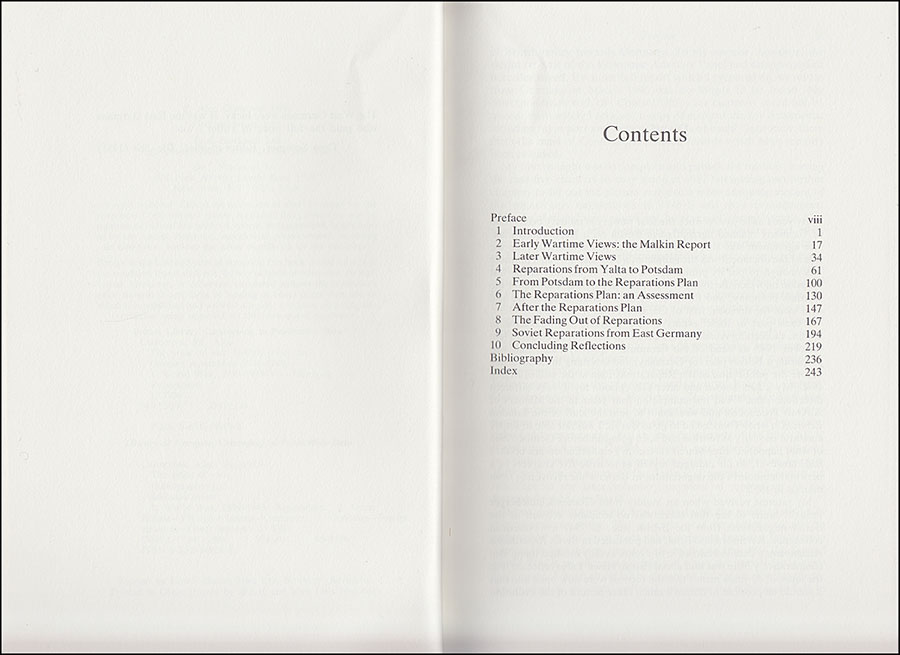
Contents
Preface
1 Introduction
2 Early Wartime Views: the Malkin Report
3 Later Wartime Views
4 Reparations from Yalta to Potsdam
5 From Potsdam to the Reparations Plan
6 The Reparations Plan: an Assessment
7 After the Reparations Plan
8 The Fading Out of Reparations
9 Soviet Reparations from East Germany
10 Concluding Reflections
Bibliography
Index
|
|
|
|
|
|
|
The Price of War
Preface
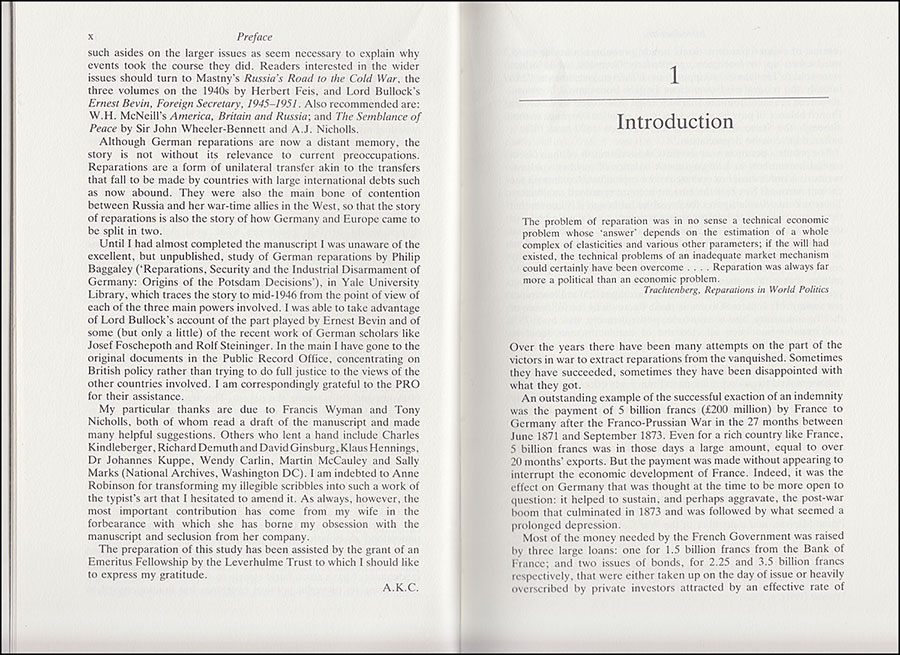
Forty years have passed since the four
powers in military occupation of Germany reached agreement in Berlin
on a Reparations Plan. The agreement was short-lived and never
whole-hearted; even the title of the document was the subject of a
long dispute and a footnote was enough to put its publication in
doubt. It was almost the last occasion on which the four powers
united in planning a future for the German economy; and the fruits
of their failure to agree are still with us in the division, first
of Germany, then of Europe.
I took part in these events as the Treasury representative in
Berlin, succeeding Austin Robinson and Donald MacDougall in late
October 1945 as head of the Economic Advisory Panel that was
preparing a British plan for Germany, and returning to London just
before the publication of the Reparations Plan at the end of March
1946. My duties before and after this episode lay in very different
directions since I had just completed four years in the Ministry of
Aircraft Production and was about to join the staff of the London
Economist when I was asked to go to Berlin. I was not able to
satisfy a natural curiosity as to what had been going on before
October 1945 or what happened after March 1946 until I embarked on
this book. I had, however, so far indulged myself as to write five
chapters of a personal memoir of the negotiations in Berlin while
recovering from mumps in 1952.
My interest revived when an inquiry from Charles Kindleberger
brought home to me that there was no available account of the Berlin
negotiations from the British side. In 1947 my American colleagues,
Ratchford and Ross, had published in Berlin Reparations Assignment a
detailed narrative of events as they recalled them. But
comparatively little was said about British views. I also reflected
that the lapse of 40 years meant that the records were now open and
that it should be possible to obtain a much fuller picture of the
evolution of British policy towards Germany. To my surprise,
however, the Berlin records of the Economic Advisory Panel had
disappeared or been destroyed. Even the full report which I prepared
on my return from Germany in March 1946 was no longer to be found.
My correspondence with the Control Office for Germany could not be
traced. Fortunately I retained a copy of many of the key documents,
including my report and various letters, and could supplement them
from the mass of Control Commission records which have recently been
released.
My first thought was to complete and publish the memoir, leaving the
first five chapters as they stood in 1952 but adding two further
chapters to fill out the picture and give a more adequate account of
the reparations negotiations in 1945-6 and their consequences.
Memoirs of such distant events are, however, of limited interest.
The reader would be left wondering what went before and what
happened afterwards, and asking how the quadripartite negotiations
in Berlin were linked with ministerial discussions and policy in
London. I decided therefore to do a full-scale study of British
reparations policy during and after the Second World War that could
be read on its own. The memoir might add colour and piquancy, but I
did not think that I could merge it with a more scholarly study,
given the wide difference in subject matter and the limited
interaction between ministerial policy and events in Berlin.
I have confined the study to German reparations, conscious that half
the countries of Europe (and many others) were claiming or paying
reparations after 1945. Albania, Egypt, Ethiopia, Greece and India
were among the claimants and Austria, Bulgaria, Finland, Hungary and
Italy among the payers. The amounts involved were often substantial
but none raised problems comparable in international importance with
the claims on Germany. I have also refrained from pursuing the
activities in Brussels of the Inter-Allied Reparations Agency (IARA),
which was intended to allocate reparations between the claimant
Countries. The narrative stops in 1949 with the creation of the
Federal Republic, and makes no reference to the later voluntary
payment of reparations by the Federal Republic to Israel.
It was difficult to decide how to deal with the political setting of
the reparations story. The quarrels over reparations cannot be
understood in isolation from other quarrels between the powers
concerned. But international relations during and after the Second
World War is an enormous subject of which my knowledge is quite
inadequate. I have stuck fairly closely to the theme of reparations,
recognizing its powerful political overtones but limiting myself to
such asides on the larger issues as seem necessary to explain why
events took the course they did. Readers interested in the wider
issues should turn to Mastny's Russia's Road to the Cold War, the
three volumes on the 1940s by Herbert Feis, and Lord Bullock's
Ernest Bevin, Foreign Secretary, 1945-1951. Also recommended are:
W.H. McNeill's America, Britain and Russia; and The Semblance of
Peace by Sir John Wheeler-Bennett and A.J. Nicholls.
Although German reparations are now a distant memory, the story is
not without its relevance to current preoccupations. Reparations are
a form of unilateral transfer akin to the transfers that fall to be
made by countries with large international debts such as now abound.
They were also the main bone of contention between Russia and her
war-time allies in the West, so that the story of reparations is
also the story of how Germany and Europe came to be split in two.
Until I had almost completed the manuscript I was unaware of the
excellent, but unpublished, study of German reparations by Philip
Baggaley ('Reparations, Security and the Industrial Disarmament of
Germany: Origins of the Potsdam Decisions'), in Yale University
Library, which traces the story to mid-1946 from the point of view
of each of the three main powers involved. I was able to take
advantage of Lord Bullock's account of the part played by Ernest
Bevin and of some (but only a little) of the recent work of German
scholars like Josef Foschepoth and Rolf Steininger. In the main I
have gone to the original documents in the Public Record Office,
concentrating on British policy rather than trying to do full
justice to the views of the other countries involved. I am
correspondingly grateful to the PRO for their assistance . . .

Introduction
Over the years there have been many
attempts on the part of the victors in war to extract reparations
from the vanquished. Sometimes they have succeeded, sometimes they
have been disappointed with what they got.
An outstanding example of the successful exaction of an indemnity
was the payment of 5 billion francs (£200 million) by France to
Germany after the Franco-Prussian War in the 27 months between June
1871 and September 1873. Even for a rich country like France, 5
billion francs was in those days a large amount, equal to over 20
months' exports. But the payment was made without appearing to
interrupt the economic development of France. Indeed, it was the
effect on Germany that was thought at the time to be more open to
question: it helped to sustain, and perhaps aggravate, the post-war
boom that culminated in 1873 and was followed by what seemed a
prolonged depression.
Most of the money needed by the French Government was raised by
three large loans: one for 1.5 billion francs from the Bank of
France; and two issues of bonds, for 2.25 and 3.5 billion francs
respectively, that were either taken up on the day of issue or
heavily overscribed by private investors attracted by an effective
rate of interest of about 6 per cent. Some bonds, probably about
one-third, were taken up by foreigners, particularly Germans, while
others were sold to Frenchmen swapping out of foreign investments.
Thus initially the money paid over came largely from capital
borrowed abroad or realized from the sale of foreign assets. The
strain on the French balance of payments was very much reduced - so
much so that although the franc was inconvertible between 1870 and
1878 it suffered little or no depreciation.
The whole operation was an early demonstration of the role of
capital movements in bringing about balance of payments adjustments:
it is much easier to operate on the capital balance than on the
current account. Not that the current account remained unaffected.
There are no reliable figures for invisibles, although it is known
that there was a large and fairly stable surplus, consisting mainly
of interest on French holdings of foreign bonds. The balance on
visibles, that is, the balance of trade, swung from a consistent
deficit averaging 340 million francs a year in 1868-71 to an equally
consistent surplus in the next four years, 1872-5, averaging 240
million francs, and then swung back again in the following four
years, 1876-9, to a growing deficit that averaged 750 million francs
per annum. It is natural to see in these fluctuations the influence
of the the indemnity, and to conclude, perhaps rashly, that by 1875
a real transfer had been effected out of current income equal to
perhaps half or more of the total indemnity, the other half being
carried as an impairment of France's net external assets.
The boot was on the other foot after 1918, when it was Germany that
was asked to pay reparations to France and other countries; the
situation then was a very different one. Whereas in 1871 a
relatively short war had left the French economy largely intact -
French exports hardly fell in value in 1870, rose in 1871 and rose
again, by over 30 per cent, in 1872 - in 1919 Germany was just
emerging from a long and exhausting war, on the verge of revolution,
blockaded and unable to trade freely. Other countries in central
Europe were in an equally impoverished condition and this both
inflamed the call for reparations and complicated the problem of
exacting them.
Very large sums were demanded. Lord Cunliffe, a former Governor of
the Bank of England, and Hughes, the Australian Prime Minister and a
member of the War Cabinet, wanted to make Germany pay the full cost
of the war, estimated at £24,000 million.
Others, like Keynes, thought that
Germany might be able to pay no more than £1,000 million, but were
prepared to recommend an indemnity of between £2,000 million and
£3,000 million. Agreement was eventually reached in Paris on claims,
including the cost of war pensions and separation allowances, that
were later estimated to amount to £6,600 million.
It has been usual to pillory the French for the outrageousness of
these claims. But it was the UK, not France, whose reparations
policy at the Paris Peace Conference was most exacting and
intransigent. Lloyd George professed moderation and reconciliation
with Germany. But he also wanted justice and justice for him meant
punishment. In the general election that followed the armistice of
November 1918 he yielded to the popular clamour to make Germany pay,
and throughout the peace negotiations continued to support demands
that he knew to be impossible. His stance, which was by no means
dictated by political pressure, committed the British Government to
a harsh and punitive policy.
Such a policy was not at first favoured by the French. At the
armistice they looked to co-operation between the Allies rather than
to reparations from Germany for a solution to their economic
problems.Their Minister of Commerce, Clementel, had plans in 1918
for a new international order which would continue into the peace
some of the kinds of international collaboration that had grown up
in the war. The main feature would have been a permanent
inter-Allied system for the pooling and control of raw materials,
with preferential tariffs within the Allied bloc. Allied
co-operation was to provide a framework for the ultimate
reintegration of Germany into the international economic system and
at the same time restrain German ambitions. As for reparations,
Clementel thought vast payments neither feasible nor desirable: they
might, however, be demanded as a means of extracting 'concessions'
(e.g. supplies of coal) from Germany and inducing recalcitrant
allies to support the idea of a world fund forihe rebuilding of the
devastated areas. These ideas foundered, however, on the refusal of
the Allies to play the role assigned to them. The French then hoped
for agreement on a moderate fixed sum in reparations with a German
bond issue in the USA to raise the money and the payment of a
substantial part of the proceeds into the French treasury. This,
too, failed. The British would not agree to the naming of a fixed
sum and it is questionable whether the Germans could have sold bonds
in America.
As a condition of the armistice the Germans had agreed to make
compensation 'for all damage done to the civilian population of the
Allies and their property by the aggression of Germany by land, by
sea and from the air'. But to war damage the British proposed to add
war costs, hoping in this way to increase their share of the total.
The French, while supporting British claims, wanted reparation,
strictly defined, to have priority. They would have liked to pool
war costs and reapportion the inter-Allied debt, each nation paying
acording to its ability. The Americans, to whom a large part of the
burden would have been transferred, would have none of this. They
were also opposed to the inclusion of war costs and the attempt to
include them was abandoned. From that point on, French proposals
fell below the British demands and the French were prepared, while
the British were not, to name a fixed sum.
The attitude of the British Government during the negotiations did
not long command popular support. Public opinion quickly swung
round, first among the troops quartered in Germany who saw the
extremities to which the Germans were reduced, and then increasingly
among the public at large. A mood of disillusionment and hostility
to the Treaty of Versailles spread as it became clear that there
would be no reconciliation, no assurance of lasting peace; the
treaty would have to be upheld by force. The French, who had most
reason to fear for their security, stood firm by the Treaty, and in
so doing attracted to themselves the condemnation of those who
wished to revise it. The idea took firm root that it had been French
vindictiveness and vengefulness that accounted for the harshness of
the terms of peace . . .
|
|
|
|
|
|
|
The Price of War
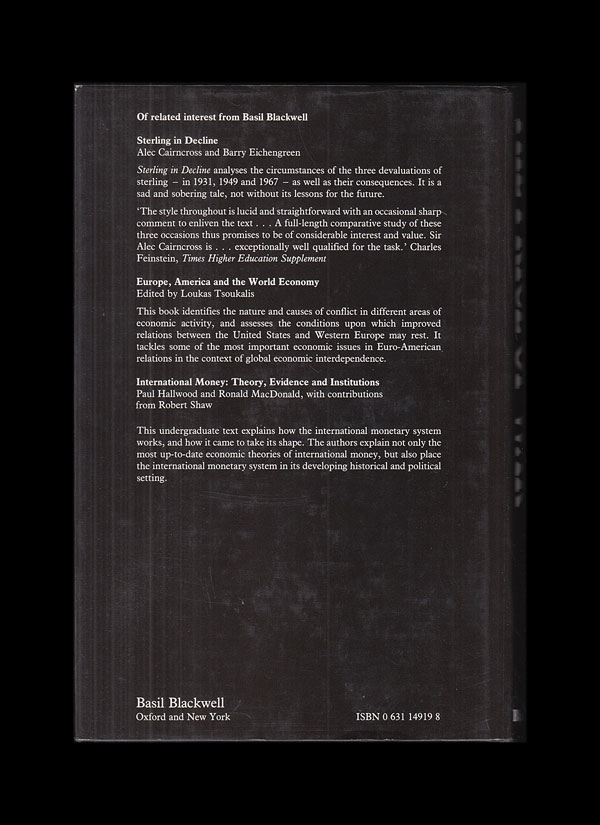
From the dust-jacket:
German reparations after World War II
were the main bone of contention between the four powers in military
occupation of the country. The agreement they reached at Potsdam in
1945 proved to be ambiguous and inconsistent. The Russians were left
free to remove what they wished from their own zone (now East
Germany) in pursuit of their claim for $10,000 million in
reparations while at the same time a reparations plan for Germany as
a whole was to be prepared on principles requiring equal treatment
of all four zones. When agreement on a plan was reached in March
1946 it was almost the last occasion on which the four powers united
in planning a future for the German economy; and the fruits of their
failure to agree are still with us in the division, first of
Germany, then of Europe.
The subsequent history presents a paradox. Western Germany paid only
trifling reparations, received extensive aid and went on to become
the richest country in Western Europe. Eastern Germany paid the USSR
something approaching $10,000 million and yet is also the richest
country in its part of Europe. The USSR received in reparations and
aid about as much as it suffered in war damage while the United
Kingdom ended up roughly $20,000 million worse off.
The story is one of the coming apart of a coalition, the breakdown
of trust between allies, obsession with the danger of yet another
world war launched by Germany and fears that in such a struggle
Germany might ally herself with 'the other camp'. Combined with this
was the contradiction between making Germany meet a substantial part
of the cost of the damage she had caused in countries struggling
against economic chaos and the effort to overcome similar chaos in
Germany.
This is the first full-length account of German reparations after
World War II from the British point of view by one who took part in
the quadripartite negotiations in Berlin that led up to the
Reparations Plan of March 1946.
Sir Alec Cairncross, Chancellor of Glasgow University and formerly
Master of St Peter's College, Oxford, was head of the Economic
Advisory Panel, Berlin, in 1945. Before returning to academic life
in 1951, he was Economic Adviser to the Board of Trade (1946-9) and
to the Organization for European Economic Co-operation (1949-50).
From 1964 to 1969 he was head of the Government Economic Service,
and has served as an independent adviser to government in various
capacities. His many publications include Introduction to Economics
(1944), now in its 6th edition (1982); Home and Foreign Investment
1870-1913 (1953); Essays in Economic Management (1971); Sterling in
Decline (1983), with Barry Eichengreen; and Years of Recovery (1985)
.
|
|
|
|
|
|
|
|
|

Please note: to avoid opening the book out, with the
risk of damaging the spine, some of the pages were slightly raised on the
inner edge when being scanned, which has resulted in some blurring to the
text and a
shadow on the inside edge of the final images. Colour reproduction is shown
as accurately as possible but please be aware that some colours
are difficult to scan and may result in a slight variation from
the colour shown below to the actual colour.
In line with eBay guidelines on picture sizes, some of the illustrations may
be shown enlarged for greater detail and clarity.

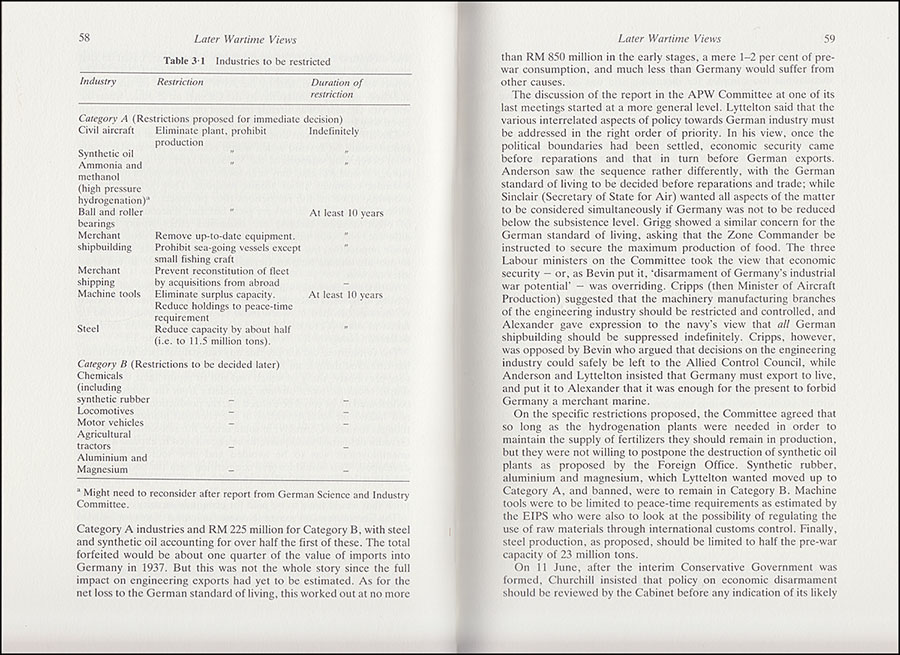
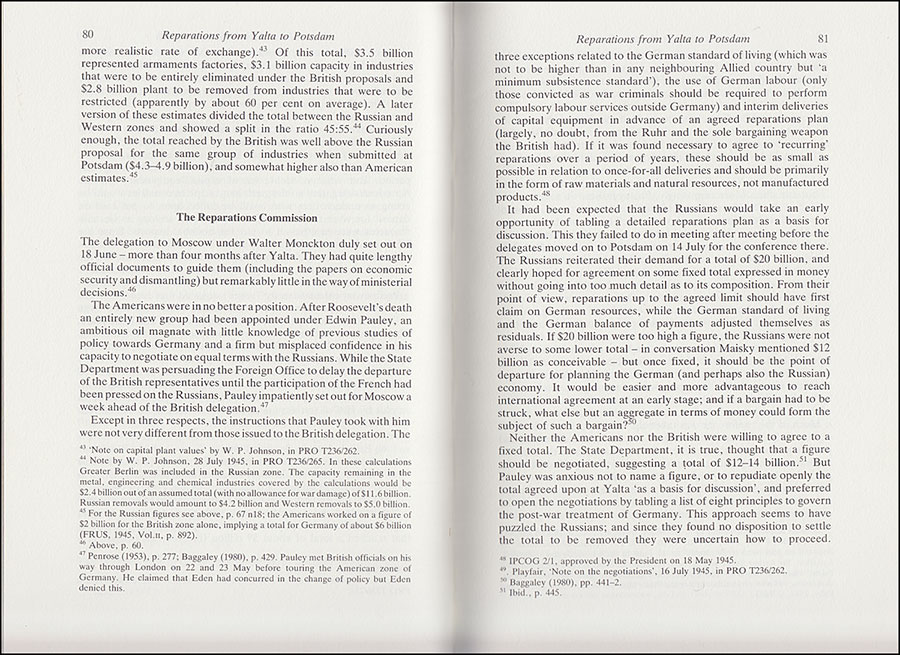
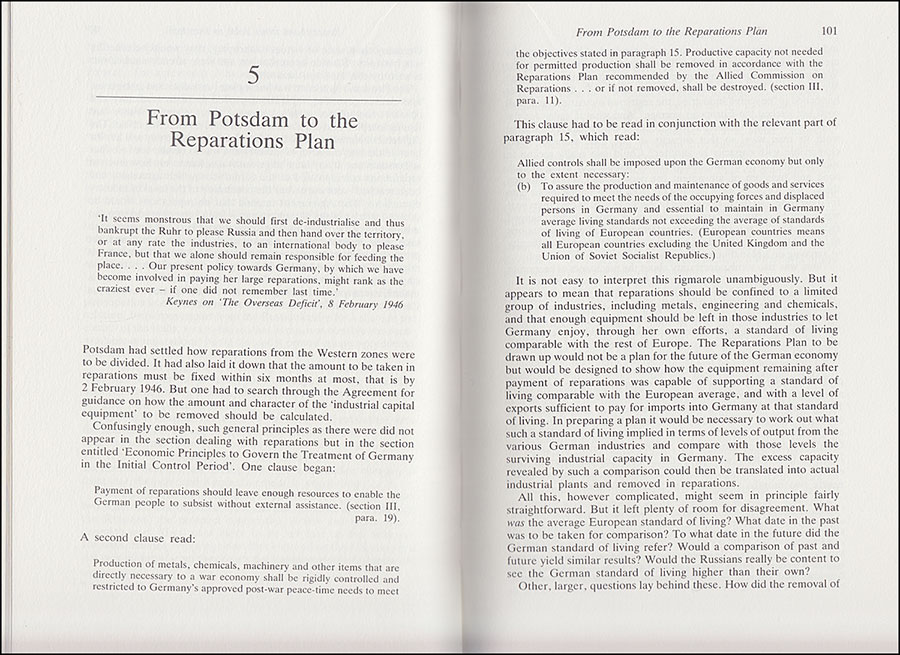
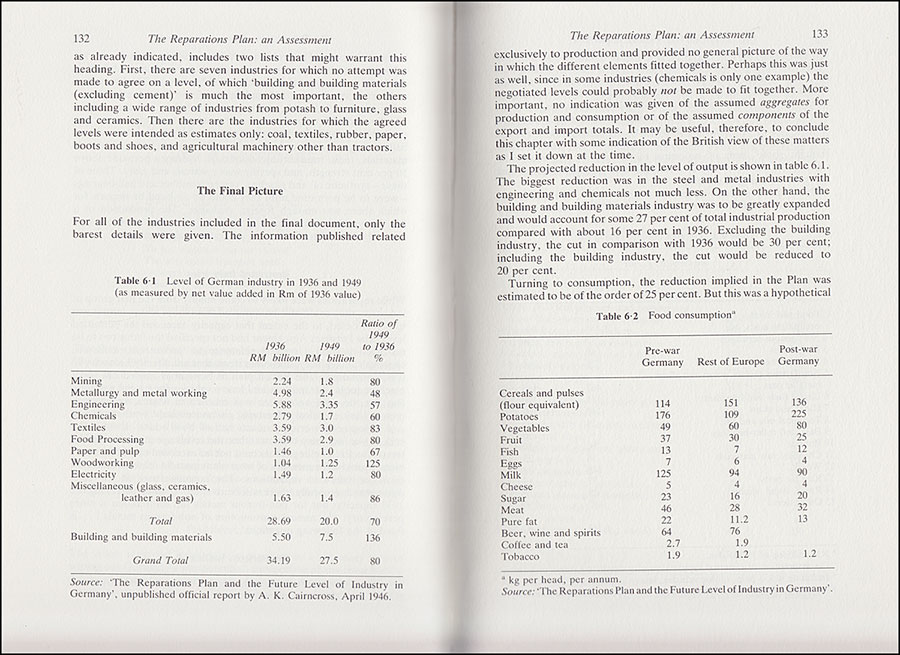
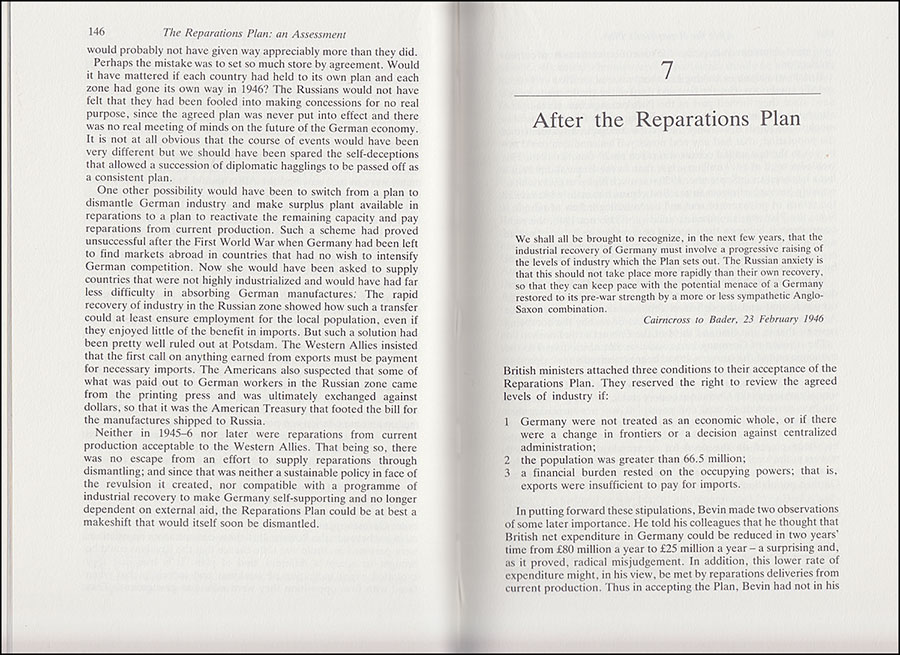
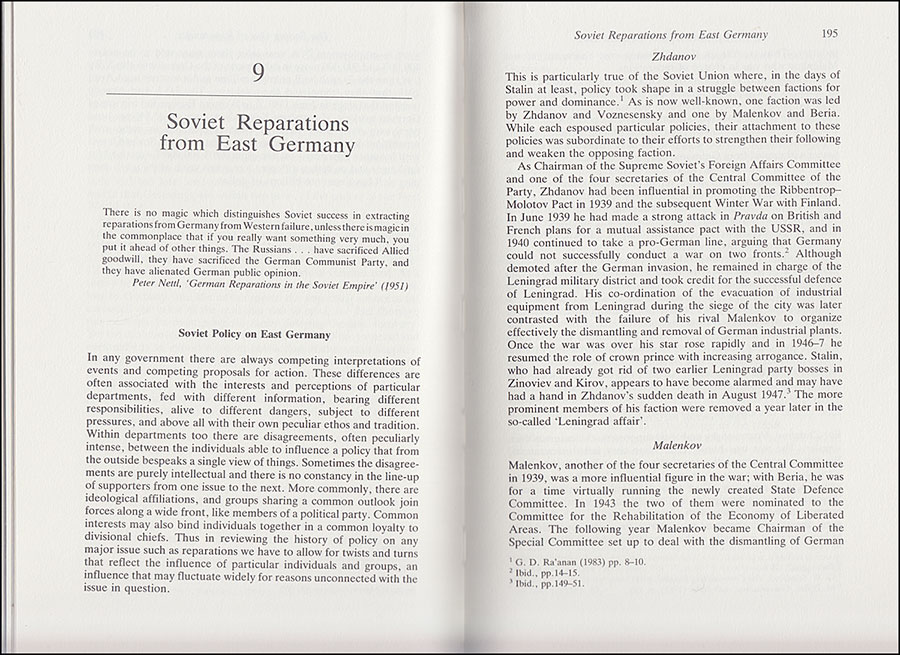 |
|
|
|
|

|
|
|
|
U.K. buyers:
|
To estimate the
“packed
weight” each book is first weighed and then
an additional amount of 150 grams is added to allow for the packaging
material (all
books are securely wrapped and posted in a cardboard book-mailer).
The weight of the book and packaging is then rounded up to the
nearest hundred grams to arrive at the postage figure. I make no charge for packaging materials and
do not seek to profit
from postage and packaging. Postage can be combined for multiple purchases. |
Packed weight of this item : approximately 700 grams
|
Postage and payment options to U.K. addresses: |
-
Details of the various postage options can be obtained by selecting
the “Postage and payments” option at the head of this
listing (above).
-
Payment can be made by: debit card, credit
card (Visa or MasterCard, but not Amex), cheque (payable to
"G Miller", please), or PayPal.
-
Please contact me with name,
address and payment details within seven days of the end of the
listing;
otherwise I reserve the right to cancel the sale and re-list the item.
-
Finally, this should be an
enjoyable experience for both the buyer and seller and I hope
you will find me very easy to deal with. If you have a question
or query about any aspect (postage, payment, delivery options
and so on), please do not hesitate to contact me.
|
|
|
|
|
|
|
International
buyers:
|
To estimate the
“packed
weight” each book is first weighed and then
an additional amount of 150 grams is added to allow for the packaging
material (all
books are securely wrapped and posted in a cardboard book-mailer).
The weight of the book and packaging is then rounded up to the
nearest hundred grams to arrive at the shipping figure.
I make no charge for packaging materials and do not
seek to profit
from shipping and handling.
Shipping can
usually be combined for multiple purchases
(to a
maximum
of 5 kilograms in any one parcel with the exception of Canada, where
the limit is 2 kilograms). |
Packed weight of this item : approximately 700 grams
| International Shipping options: |
Details of the postage options
to various countries (via Air Mail) can be obtained by selecting
the “Postage and payments” option at the head of this listing
(above) and then selecting your country of residence from the drop-down
list. For destinations not shown or other requirements, please contact me before buying.
Due to the
extreme length of time now taken for deliveries, surface mail is no longer
a viable option and I am unable to offer it even in the case of heavy items.
I am afraid that I cannot make any exceptions to this rule.
|
Payment options for international buyers: |
-
Payment can be made by: credit card (Visa
or MasterCard, but not Amex) or PayPal. I can also accept a cheque in GBP [British
Pounds Sterling] but only if drawn on a major British bank.
-
Regretfully, due to extremely
high conversion charges, I CANNOT accept foreign currency : all payments
must be made in GBP [British Pounds Sterling]. This can be accomplished easily
using a credit card, which I am able to accept as I have a separate,
well-established business, or PayPal.
-
Please contact me with your name and address and payment details within
seven days of the end of the listing; otherwise I reserve the right to
cancel the sale and re-list the item.
-
Finally, this should be an enjoyable experience for
both the buyer and seller and I hope you will find me very easy to deal
with. If you have a question or query about any aspect (shipping,
payment, delivery options and so on), please do not hesitate to contact
me.
Prospective international
buyers should ensure that they are able to provide credit card details or
pay by PayPal within 7 days from the end of the listing (or inform me that
they will be sending a cheque in GBP drawn on a major British bank). Thank you.
|
|
|
|
|
|
|

(please note that the
book shown is for illustrative purposes only and forms no part of this
listing)
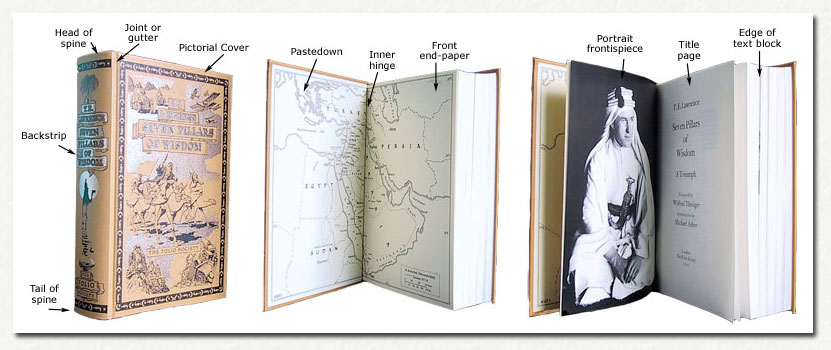
Book dimensions are given in
inches, to the nearest quarter-inch, in the format width x height.
Please
note that, to differentiate them from soft-covers and paperbacks, modern
hardbacks are still invariably described as being ‘cloth’ when they are, in
fact, predominantly bound in paper-covered boards pressed to resemble cloth. |
|
|
|
|
|
|

Fine Books for Fine Minds |
I value your custom (and my
feedback rating) but I am also a bibliophile : I want books to arrive in the
same condition in which they were dispatched. For this reason, all books are
securely wrapped in tissue and a protective covering and are
then posted in a cardboard container. If any book is
significantly not as
described, I will offer a full refund. Unless the
size of the book precludes this, hardback books with a dust-jacket are
usually provided with a clear film protective cover, while
hardback books without a dust-jacket are usually provided with a rigid clear cover.
The Royal Mail, in my experience, offers an excellent service, but things
can occasionally go wrong.
However, I believe it is my responsibility to guarantee delivery.
If any book is lost or damaged in transit, I will offer a full refund.
Thank you for looking.
|
|
|
|
|
|
|
Please also
view my other listings for
a range of interesting books
and feel free to contact me if you require any additional information

Design and content © Geoffrey Miller |
|
|
|
|
|
|