











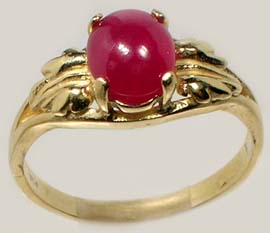
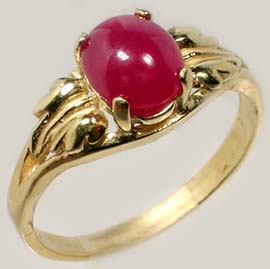
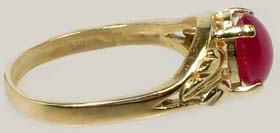
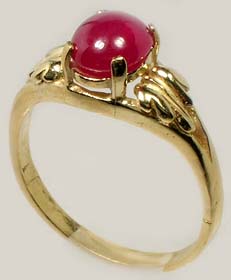
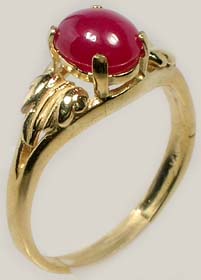
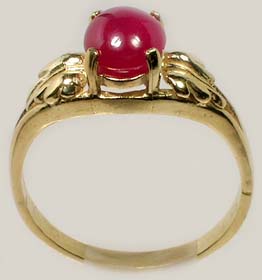
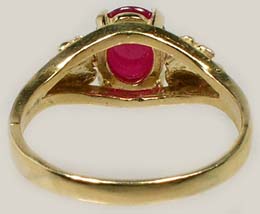
Antique 18th Century Genuine Natural Good Quality Hand Crafted One and Three-Quarter Carat Plus Ruby Oval Precious Gemstone. Contemporary High Quality Solid 14kt Yellow Gold Ring (Size 8).
ORIGIN: Handcrafted in Russia, 18th Century. 14kt Yellow Gold ring setting is contemporary.
SIZE: Length: 8mm. Width: 6mm. Depth: 4mm. Measurements approximate.
WEIGHT: 1.76 carats.
DETAIL: In Sankskrit, an ancient language of India (source of much of the ancient world's ruby), ruby was called "ratnaraj", which means "King of Gems". Rubies were sorted into upper class, middle class, and lower class stones in relation to their color, flawlessness and beauty. Much like Indian society today, no inferior ruby was allowed contact with an upper class ruby because it was believed the low-caste ruby would contaminate the better one, thereby diminishing its magical powers. Ruby was sometimes worn beneath the skin by warriors as a protective talisman with the belief that the ruby would give them courage and make them invulnerable. In the ancient classical world, rubies from Afghanistan, Ceylon, and B were traded in the ancient port cities of the Eastern Mediterranean (often by Phoenicians), and from there traveled throughout Europe.
Celebrating this cultural legacy here's a remarkable and beautiful antique ruby precious gemstone. The gemstone was hand shaped and polished by an 18th century Russian artisan, part of an heritage renown for the production of the elaborate gemstones and jewelry of the Czars of Medieval, Renaissance, and Victorian Russia. As you can see for yourself, the ruby is of stunning quality, transparent, a beautiful, regal red hue. Of course most ruby gemstones are anywhere from lightly to heavily blemished, typically with colorless crystalline material, sometimes with black carbon specks. The colorless crystalline blemishes are almost a hallmark characteristic of natural ruby, and take the form of either seams of colorless crystalline material, or in the form of microscopic colorless crystals, which while not individually discernible, do nonetheless in sufficient density create a "haziness" within the gemstone, causing the character to shift from that of being transparent, to that of being translucent, or even opaque.
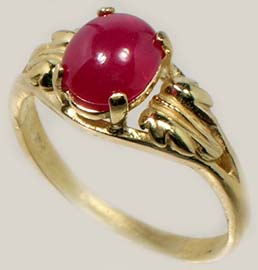
Unfortunately most completely transparent rubies you see offered today at retail are synthetic. While this particular specimen might not be with flaw, toe the eye it is seemingly without blemish, quite clean and without any dark inclusions or flaws which are noticeable with casual scrutiny. Of course at magnification (as in the accompanying photo enlargements) it is seen to possess a few very faint blemishes composed of the colorless crystalline material so characteristic of natural ruby. However none of these colorless crystalline blemishes are easily discerned by the naked eye, and even in these photo enlargements, they are not easy to discern. To the cursory inspection of the casual admirer, the gemstone is simply of gorgeous red ruby which is seemingly without flaw. And the gemstone does possess the much sought after bright blood red color which has captivated mankind for eons.
The ruby is definitely toward the higher end of the quality spectrum. The setting is of contemporary origin. It is a high quality setting manufactured by one of the USA’s leading semi-custom mount producers. It is constructed of solid 14kt yellow gold (NOT merely gold plate). The ring is also available in white gold, and there are many other ring styles available. Some are most costly, some less. If you would like to see the other ring styles available for this gemstone, just contact us, we would be happy to share them with you. We do have the ability to have the ring sent out for resizing if requested. Additionally, if preferred, the mounting is also available in sterling silver (at reduced cost).
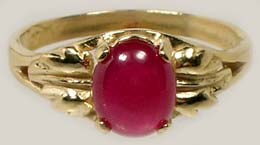
As might be expected under magnification the gemstone shows the unmistakable, hallmark characteristics of having been hand crafted. The coarseness of the 18th century finish is considered desirable to most gemstone aficionados, and is not considered a detriment, or detract from the value of a gemstone. These characteristics are not only expected of hand-finished gemstones, many believe that such antique hand-crafted gemstones possess much greater character and appeal than today's mass-produced, machined gemstones. Unlike today’s computer controlled machine produced gemstones that approach flawlessness in a perfect finish, the cut and finish of an antique, handcrafted gemstone such as this is the legacy of an artisan who lived two centuries ago.
Handcrafted though it may be the gemstone possesses great luster and character, but it is not absolutely flawless. True, the blemishes it possesses are virtually invisible to the naked eye, and to use trade jargon the gemstone can be characterized as "eye clean". However in the accompanying photo enlargements you may be able to pick out a few slight blemishes composed of the colorless crystalline material so characteristic of natural ruby, barely discernible even at magnification. Of course much the same may said about almost any antique gemstone of natural origin, and in particular with regard to natural ruby. An absolutely flawless gemstone simply is not the rule in nature. Most absolutely flawless gemstones will upon close examination be revealed to be synthetic. You might also notice under magnification occasional irregularities in the cut and finish. Naturally these characteristics are not only expected of hand-finished gemstones, you must also consider that two centuries ago the mining techniques even possible then, let alone in practice, did not allow the ultra deep mining operations which are so commonplace today.
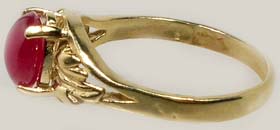 Keep in mind two centuries ago mankind was more or less limited to surface deposits or near surface deposits of gemstones. Higher quality gemstones which today are routinely mined from beneath hundreds of meters, even kilometers beneath the earth's surface, were simply inaccessible then. It is precisely for these reasons antique gemstone must be appreciated as antiques first, gemstones second. The relatively superlative quality of contemporary gemstones mined from deep beneath the earth's surface were simply not accessible two centuries ago, or at least, only rarely so. However for most, the unique nature and character of these antique gemstones more than makes up for the blemishes found within the gemstones, as well as the cutting and finishing irregularities common to handcrafted gemstones, all of which are by and large are only visible under magnification.
RUBY HISTORY: The name ruby comes from the Latin "rubeus" (red). In the ancient world ruby was believed to possess magical powers, and was worn as a talisman for protection from plagues, poison, sorrow, and evil spirits. The ruby symbolized freedom, charity, dignity and divine power, and was associated with fire and blood, implying warmth and life for mankind. Some ancient cultures believed that rubies, as well as other gemstones, grew on trees, just like fruit. The rubies would begin budding as small white gems, and would slowly grow and ripen, turning red in the light of the sun. When the ruby was saturated with red color, it was ready to be plucked. In the classical world, rubies from Afghanistan, Ceylon, India and B were traded in the ancient port cities of the Eastern Mediterranean (often by Phoenicians), and from there traveled throughout Europe.
However it is believed that most of the ancient world’s ruby came from Ceylon, where evidence suggests ruby may have been mined for the past 20,000 years. Archaeologists have uncovered ancient Etruscan jewelry with Celanese ruby which dates back to the seventh century B.C. However scientists believe that ruby has also been mined in B since Paleolithic and Neolithic times as well, as tools have been excavated by archaeologists dating both to the Bronze Age as well as backwards into the Stone Age. In ancient literature, the ruby was described both by the fourth century B.C. Greek Philosopher/Scientist Theophratus (student and successor of Plato and Socrates) as well as by Pliny, the first century A.D. Roman historian and naturalist. In ancient Rome the ruby was associated with the principles of justice and its administrators (the judicial system).
Ancient literature from China indicates that ruby was traded along the northern silk route, moving westward into Europe. The Bible as well makes numerous mentions of ruby, first as one of the twelve precious stones created by God when he created mankind. Ruby is then described as “the lord of gems” when one was given to Aaron on the command of God. And ruby adorned Aaron's breastplate and was symbol of Judah. The Bible also frequently states that the high value of ruby was only exceeded by wisdom and by virtuous women, implying that ruby indeed was exceptionally valuable. The Greeks believed that the "fire" evidenced by a ruby's red coloration could melt wax. Greeks legends speak about huge rubies which were given to Heraclea by the female stork to lighten her room as a token of her kindness.
The ancient populations of the Mediterranean also believed that the color of a ruby would change mirroring changes in the health of its owner, and that the color would drain from a ruby at the moment its owner died. In Antiquity and through the Middle Ages it was believed that the cosmos was reflected in gemstones. Ruby was associated with the planet Mars. Ruby was deemed to be the most precious of gemstones not only in the Bible, but also in ancient Sanskrit writings. In Sanskrit, an ancient language of India, ruby was called "ratnaraj", which means "King of Gems". To them, this fiery stone burned with an inextinguishable fire, capable of boiling the water in which it was placed. Ancient Indian legends said that God first created ruby and later created man to possess it, and that he who offered rubies to the gods would be reincarnated as a powerful king or emperor.
In ancient India rubies were also sorted into upper class, middle class, and lower class stones in relation to their color, flawlessness and beauty. Much like Indian society today, no inferior ruby was allowed contact with an upper class ruby because it was believed the low-caste ruby would contaminate the better one, thereby diminishing its magical powers. In nearby ancient B it was felt a ruby must not just be worn, but embedded in the skin to become part of the body, thus making the wearer invulnerable. Up in time through Medieval Europe, rubies were worn as a talisman for protection against unhappiness, lightening and upsetting dreams. The ruby was also believed to encourage bliss, and was used to treat fever and heart disorders relating to blood flow through the ventricles. It was also believed that when worn on the left hand or in a brooch on the left side, ruby enabled the wearer to live in peace among enemies.
Ruby was greatly valued in the Medieval Arab world. There are many references to ruby in ancient Arabic literature, including many references to “yakut”, a term used for red corundum (ruby) during the sixth through tenth centuries, culminating in a noteworthy treatise by the 11th century Arab scholar Al-Biruni, who conducted specific gravity determinations on a whole series of gemstones. Throughout Medieval Central Asia, the Near East, and China ruby was used to ornament armor, scabbards, and harnesses of noblemen. Rubies were laid beneath the foundation of buildings to secure good fortune to the structure. Much of the ruby reaching early Medieval Europe came from Badakshan, on the border between present-day Tajikistan and Afghanistan. Marco Polo described visiting these mines in his accounts of his travels. Later Medieval Europe’s rubies came principally from the border region between B and Siam (present-day Thailand).
In Medieval Europe, rubies were considered even more valuable than diamonds. In 16th century ruby was priced 8 times higher than diamond. Rubies were viewed as a stone of prophecy, used by medieval shamans and sorcerers to divine the future. Ruby was also worn as a talisman, as it was believed that the stone darkened when danger was near and then returned to its original color when the danger was past. It was believed that wearing ruby would attract good health, wisdom, fortune, and true love. Ruby was also thought to be an antidote to poisoning as well. In England, ruby was used for royal coronation rings. Medieval Europe also believed that ruby had important medical applications. A thirteenth century prescription to cure liver problems called for powdered ruby, and it was also believed that when rubbed on the skin, ruby would restore youth and vitality. Ivan the Terrible of Russia stated that rubies were good for the heart, brain and memory.
Rubies are mined all over the world, but the highest quality gemstones come from B, Ceylon, and Siam, then India, Madagascar, Russia, Zimbabwe, Afghanistan, Pakistan, Kenya, Tanzania, Mexico, and North Carolina in the USA. Ruby is the red variety of corundum, the second hardest natural mineral known to mankind. The non-red variety of corundum is Sapphire. Sapphires are well known among the general public as being blue, but can be nearly any color. A ruby's color is due to a trace of chromic oxide; the amount of this trace mineral determines the depth of color. The most sought after shade of red for ruby is often given the name "pigeon blood red", but ruby can be any shade of red up to almost pink.
In Mogok, the rubies are mined by natives according to centuries-old customs. From ancient times through the Middle Ages and into the Victorian period, all Mogok rubies belonged to the King. There are references to several rubies in the weight range between 100 and 400 carats reportedly mined during the nineteenth century and presented to the King of B. It is known that in the nineteenth century the British Museum of Natural History acquired a 167 carat B ruby which remains there today on display, and there also exists a 196 carat specimen at the Los Angeles County Museum of Natural History. Two massive, uncut rubies which remain the possession of the B government include “the Sun of Mogok”, weighing 1743 carats, and the “Navara Ruby”, weighing 505 carats.
The famous "Hill of Precious Stones", near Bangkok, Thailand, yields rubies of a deeper shade with purple undertones. Rubies from Ceylon (Sri Lanka) tend toward violet, and are lighter in color. Oriented rutile crystal inclusions cause a six-rayed-star light effect (called asterism) to form the popular "Star Ruby". The "Star Ruby" is also known as a "Mysore Ruby" as the majority are mined in Mysore, India. However the largest star ruby known is a 138.7 carat specimen which was mined from Ceylon, and is presently at the Smithsonian in Washington, D.C. The color of ruby is accompanied by a marked fluorescence, which is stimulated by natural and artificial light making rubies turn brighter red under such light. The King of Ceylon was said to possess a ruby that shone so brightly that when he brought it out at night, it would light up the entire palace.
Experts consider that the color is ruby’s most important attribute, while its transparency is secondary. It is almost impossible to find a ruby of finer quality over 3 carats in size, therefore, minor blemishes are deemed acceptable and most ruby jewelry is made with stones under 3 carats. In fact the blemishes within a ruby are like fingerprints, proving its authenticity and revealing the beauty and the individuality of each stone. Throughout the history of the ancient world, gemstones were believed capable of curing illness and providing protection. Found in Egypt dated 1500 B. C., the "Papyrus Ebers" offered one of most complete therapeutic manuscripts containing prescriptions using gemstones and minerals. Gemstones were not only valued for their medicinal and protective properties, but also for educational and spiritual enhancement.
In these as well as other ancient cultures, it was believed that rubies brought health, wealth, wisdom, and success in love to those who wore them. The ruby was associated with the sun, and was thought to preserve both mental and physical health. The medicinal uses of ruby included its use to overcome exhaustion and calm hyperactivity. Ruby was also used to detoxify the body and blood, treat fevers, diseases, and restricted blood flow. Wearing ruby was believed to benefit the heart and circulatory system and stimulate the adrenals, kidneys, reproductive organs and spleen. According to one ancient text, ground to a fine powder and placed on the tongue, ruby was used to cure blood diseases, stop bleeding, ensure good health, bring peace, and treat indigestion. Ruby was also believed to be an effective treatment for backaches.
On the metaphysical plane, for thousands of years, ruby was considered the stone of love, passion, and power. It was believed to represent masculinity, nobility, and valor in men; pride, seductiveness, and passion in women. Ruby was believed to restore vital life forces and increase energy, vigor, and zest for life. Ruby was also regarded as the stone of courage, ancient sources citing that the wearer of ruby could pass through life without fear of evil or misfortune, and that ruby would make the wearer invulnerable to wounds, an especially useful attribute for ancient warriors. Wearing ruby was believed to strengthen the wearer during times of controversy or dispute, to shield against physical attack, to enhance creativity and spirituality, and to inspire confidence and self-esteem. Ruby was also believed to be capable of arousing passion and enthusiasm and attracting sexual activity. Even today in Asia ruby is worn by businessmen who believe that ruby improves motivation and the setting of goals, and promotes dynamic leadership. They are believed to heighten one’s state of mind, sharp, hyper-aware and focused.
A HISTORY OF GOLD: Gold, chemical symbol Au (from the Latin aurum meaning ‘shining dawn’), is a precious metal which has been used since antiquity in the production of jewelry, coinage, sculpture, vessels and as a decoration for buildings, monuments and statues. Gold does not corrode and so it became a symbol of immortality and power in many ancient cultures. Its rarity and aesthetic qualities made it an ideal material for ruling classes to demonstrate their power and position.
First found at surface level near rivers in Asia Minor such as the Pactolus in Lydia, gold was also mined underground from 2000 B.C. by the Egyptians and later by the Romans in Africa, Portugal and Spain. There is also evidence that the Romans smelted gold particles from ores such as iron pyrites. Easily worked and mixed with other metals such as silver and copper to increase its strength and change its color, gold was used for a wide range of purposes.
In most ancient cultures gold was popular in jewelry and art because of its value, aesthetic qualities, ductility and malleability. Electrum (the natural alloy of gold and silver) was used in jewelry by the Egyptians from 5000 B.C. Gold jewelry was worn by both men and women in the Sumer civilization around 3000 B.C. and gold chains were first produced in the city of Ur in 2500 B.C. The Minoan civilization on Crete in the early 2nd millennium B.C. is credited with producing the first cable chain jewelry and the Minoans made a vast array of jewelry items using an extensive range of techniques.
Gold jewelry took the form of necklaces, bracelets, earrings, rings, diadems, pendants, pins and brooches. Techniques and shapes included filigree (a technique known to the Egyptians from 2500 B.C.) where the gold is pulled into wire and twisted into different designs), beaten thin shapes, granulation (surface decoration with small, soldered granules of gold), embossing, chasing, inlaying, molding and engraving. In South America, gold was similarly worked by the Chavin civilization of Peru around 1200 B.C. and gold casting was perfected by the Nazca society from 500 B.C. The Romans used gold as a setting for precious and semi-precious gemstones, a fashion continued into the Byzantine era with the use of pearls, gems and enamels.
Gold was first used as coinage in the late 8th century B.C. in Asia Minor. Irregular in shape and often with only one side stamped, the coins were usually made of electrum. The first pure gold coins with stamped images are credited to king Croesus of Lydia, 561-546 B.C. and a contemporary gold refinery has been excavated at the capital, Sardis. Even the purest naturally occurring gold can contain 5% silver but the Lydians were able to refine their gold using salt and furnace temperatures of between 600 and 800°C.
The salt mixed with the silver and formed a vapor of silver chloride leaving behind pure gold which could be used to create a standardized coinage of guaranteed gold content. The Mycenaean civilization also widely used gold coins, as did the later Greek and Roman Empires, although silver was the more usual material used. One of the most famous gold coins in antiquity was the Roman bezant. First introduced in the reign of Emperor Constantine it weighed up to 70 Troy grains and was in currency from the 4th to the 12th centuries A.D.
The value and beauty of solid gold made it an ideal material for particularly important political and religious objects such as crowns, scepters, symbolic statues, libation vessels and votive offerings. Gold items were sometimes buried with the dead as a symbol of the deceased’s status and the conspicuous (and non-profitable) consumption of such a rare and valuable material must surely have been designed to impress. Perhaps the most famous example is the so-called mask of Agamemnon found at Mycenae.
In the Inca civilization of Peru gold was considered the sweat of the sun god Inti and so was used to manufacture all manner of objects of religious significance, especially masks and sun disks. In ancient Colombia gold was similarly revered for its luster and association with the sun and in powdered form was used to cover the body of the future king in a lavish coronation ceremony which gave rise to the legend of El Dorado.
As a decorative covering, gold plate and gold leaf (gold beaten into extremely thin sheets) have been used to decorate shrines, temples, tombs, sarcophagi, statues, ornamental weapons and armor, ceramics, glassware and jewelry since Egyptian times. Perhaps the most famous example of gold leaf from antiquity is the death mask of King Tutankhamun.
Gold, with its malleability and incorruptibility, has also been used in dental work for over 3000 years. The Etruscans in the 7th century B.C. used gold wire to fix in place substitute animal teeth. As thread, gold was also woven into fabrics. Gold has also been used in medicine, for example, Pliny in the 1st century B.C. suggests gold should be applied to wounds as a defense to ‘magic potions’.
Concerns over the authenticity of gold led the Egyptians to devise a method to determine the purity of gold around 1500 B.C. (or earlier). This method is called fire assaying and involves taking a small sample of the material under test and firing it in a small crucible with a quantity of lead. The crucible was made of bone ash and absorbed the lead and any other base metals during the firing process leaving only gold and silver. The silver was removed using nitric acid and the remaining pure gold was weighed and compared to the weight before firing.
Archimedes was also aware that the specific gravity of gold is altered depending on the percentage content of base metals, pure gold having twice the gravity of silver for example. Gold is such a precious material that for centuries various attempts were made to produce it through alchemy - that is the chemical transformation of base metals into gold using the philosopher’s stone (lapis philosophorum). First attempts were made in China in the 4th century B.C. and also in ancient Greece and although unsuccessful, nevertheless, the activity laid the foundations of modern chemistry. [Ancient History Encyclopedia].
Gold in the Ancient World: From the earliest of times, gold was often held in awe as the symbol of divinity and was therefore the material of choice for religious objects. Gold was among the first metals to be mined because it commonly occurs in pure form (not combined with other elements), because it is beautiful and imperishable, and because exquisite objects can be made from it. Since gold is found uncombined in nature, early goldsmiths would collect small nuggets of gold from stream beds etc., and then weld them together by hammering. It was oftentimes discovered alloyed with 10%-20% silver, the mixture known as “electrum”. Gold was "discovered" well before 6,000 B.C., most likely in Mesopotamia, though some of the oldest gold objects made by mankind were discovered by archaeologists in present-day Bulgaria (ancient Thrace) and in the Balkans, such as at the Varna Necropolis.
In ancient Egypt all gold was the property of the pharaoh. Artifacts and jewelry of gold over 5,000 years old have been uncovered by archaeologists in Egyptian tombs. Around 3,600 B.C. Egyptian goldsmiths carried out the first smelting of ores using blowpipes made from fire-resistant clay to heat the smelting furnace. Ancient Egyptian hieroglyphs describe gold as the brilliance of the sun. In the Near East, by 2,500 B.C., Sumerian goldsmiths were using sophisticated metalworking techniques; cold hammering, casting, soldering, cloisonné, and particularly filigree (fine-wire ornamentation) and granulation (the use of minute drops of gold). The tomb of the Sumerian Queen Puabi, from the city of Ur in about the 26th century B.C., was one of the richest tombs ever uncovered by archaeologists.
Queen Puabi was buried with five soldiers and thirteen "ladies in waiting" who had apparently poisoned themselves (or been poisoned) to serve their mistress in the next world. The grave goods she was buried with included a magnificent, heavy, gold headdress made of golden leaves, rings, and plates; a superb lyre complete with a gold and lapis-lazuli encrusted bearded bulls head; a profusion of gold tablewear; cylindrical beads of gold, carnelian, and lapis lazuli woven into extravagant necklaces and belts; a chariot adorned with lioness' heads in silver, and an abundance of silver, lapis lazuli, and gold rings and bracelets.
Another of the most famous tombs uncovered by archaeologists was that of 14th century B.C. Tutankhamun. The pharaohs of Egypt insisted on being buried in gold, which they believed was the "flesh of the gods." The boy-king Tutankhamun was enshrined in three gold coffins. The third and final coffin was made of 243 pounds (110 kilograms) of solid gold. As well, gold artifacts and jewelry abounded, including the solid gold mask which weighed 10 kilos (24 pounds). It’s worth noting that Tutankhamun was a minor, almost unknown and forgotten pharaoh. One can only imagine the wealth of gold some of ancient Egypt’s more significant pharaohs (such as Ramses the Great) must have been buried with.
The art of fashioning gold jewelry reached the Mediterranean island of Crete (the ancient Minoans) about 2400 B.C. Diadems, hair ornaments, beads, bracelets, and complex chains have been found in Minoan tombs. Near Eastern techniques of filigree and granulation were introduced to Crete about 2000 B.C., and evidence also indicates that Egyptian styles influenced Minoan jewelry. Minoan culture and its jewelry styles spread to the mainland of Greece, then dominated by the city-state of Mycenae, about 1550 B.C. The graves of nobles at the ancient Citadel of Mycenae discovered by Heinrich Schliemann in 1876 likewise yielded a great variety of gold figurines, masks, cups, diadems, and jewelry, plus hundreds of decorated beads and buttons. These elegant works of art were created by skilled craftsmen more than 3,500 years ago.
Metalworking techniques reached northern Europe by about 2000 B.C., and the earliest jewelry found there dates from between 1800 and 1400 B.C. These artifacts include lunulae (spectacular, crescent-shaped neck ornaments of beaten gold), most of which were found in graves in Ireland, where gold was once plentiful. There is evidence that the Celtic and early British people were trading with the Eastern Mediterranean races by this time, exchanging gold for faience beads. By 1200 B.C. jewelry making was flourishing in Central and Western Europe, where bronze as well as gold was frequently used to make jewelry, and the spiral was the most common motif of decoration. The fibula-brooch seems to have been invented at about this time.
Twisted gold torcs, modeled on Scandinavian bronze prototypes, were made in the British Isles and northern France from the fifth to the first century B.C. These massive circlets for the necks and arms were the characteristic ornaments of the chiefs of the Celtic race, and were symbols of wealth, power and courage across Celtic Europe. Celtic craftsmen also used enamel and inlay to decorate jewelry. By the seventh century B.C. the Etruscans of Central Italy were also making fine gold jewelry. These people may have migrated from Anatolia (present-day Turkey), from where their metalworking skills seem to have been derived. The Etruscans brought to perfection the difficult technique of granulation, whereby the surface of the metal is covered with tiny gold grains.
Gold was plentiful in Greece during the Hellenistic Age (323-30 B.C.), and Greek jewelry of this period is characterized by its great variety of forms and fine workmanship. Naturalistic wreaths and diadems were made for the head, and a variety of miniature human, animal, and plant forms were made up into necklaces and earrings. The so-called Heracles-knot, of amuletic origin, was introduced, and remained a popular motif into Roman times. The ancient Mediterranean civilizations appear to have obtained most their supplies of gold from various deposits in the Middle East, as well as gold which came through the Middle East from Southern Africa, and perhaps a minor amount from the Ural Mountains of present-day Russia.
Mines in the region of the Upper Nile (south of Egypt) near the Red Sea and in the Nubian Desert area supplied much of the gold used by the Egyptian Pharaohs (the area was known to the ancient Egyptians as “Punt”, and to the ancient Christians as “Sheba” or “Saba”). When these mines could no longer meet Egypt’s demand for gold, deposits elsewhere were exploited, likely including deposits thousands of miles away in Southern Africa. Archaeological evidence indicates that most of the gold in Ancient Egypt and even in the ancient Mediterranean from perhaps 1700 B.C. onwards came from the Himyarites in present-day Yemen (across the Red Sea from Nubia), who in addition to exploiting their own deposits, may in turn have obtained much of the gold they exported to the ancient Egyptians from present day Rhodesia/Zimbabwe.
In fact the Himyarites likely controlled most of the east coast of Africa, including Rhodesia/Zimbabwe, and is most likely the area referred to as Monomotapa in ancient texts (known also as the Biblical city of Ophir, from which the Bible records that King Solomon received shipments of gold, silver,
Around 1500 B.C. artisans of the ancient world developed the “lost wax” method of producing jewelry, allowing for the “mass production” of gold jewelry. At the same time, gold had already become the recognized medium of exchange for international trade. The sixth century B.C. saw the first use of gold in dentistry by the ancient Egyptians, and the introduction of the first gold coinage in Asia Minor by King Croesus of Lydia. By this time, much of the gold in the Classical Mediterranean cultures came from Spain, where extensive deposits of gold and silver were mined and then acquired by the ancient Phoenicians in trade, and then brought from the Western Mediterranean and traded through the ancient Mediterranean world.
Eventually the Phoenician colony of Carthage became the leading power of the Eastern Mediterranean, and gained control over these valuable Spanish deposits. In turn the Carthaginians engaged the Romans in three wars before Spain was lost to the Romans. Spanish gold and silver to a great extent allowed the Romans to expand their empire. The “other” great power of the Classical Mediterranean were the Hellenic Greeks, who by 325 B.C. were mining gold from Gibraltar to Asia Minor. When the gold in Spain began to play out, the Romans turned their attention toward the gold mines in Dacia (modern Romania). The Dacians had historically traded this gold to the Greeks for pottery and to the Scythians for amber. About 100 A.D. the Roman Emperor Trajan conquered Dacia, mainly in order to gain control of these gold mines.
The Romans also exploited smaller gold deposits found in the British Isles. The Romans used very sophisticated extraction and mining techniques as detailed by the first-century historian and naturalist Pliny the Elder. The Romans were also the first to mass-produce coinage on a monumental scale, the first truly monetized society. Between the second and fourth centuries A.D., the Romans produced millions of gold aureus coins, and billions of silver and bronze coins. At the height of the Roman Empire, there were over 400 mints producing coinage in locations scattered through their dominion. Gold was fashioned into Greek style jewelry during the early Roman Empire, when the chief centers of production were Alexandria, Antioch, and Rome, to which Greek craftsmen had migrated.
There was an increasing emphasis in producing gold jewelry on incorporating decorative stones; at first garnets, chalcedonies, and carnelians, but later uncut but polished hard gemstones such as diamonds, sapphires, and, notably, emeralds from “Cleopatra’s Mines” in Egypt. Colorful gemstone jewelry was common during the Early Middle Ages in the centuries immediately following the collapse of the Roman Empire. Mediterranean goldsmiths continued to produce jewelry of great refinement, but the jewelry of the European Celtic tribes dominated this period. They produced abstract styles of great splendor which were worked in enamels and inlaid stones. The fibula-brooch reached extremes of size and elaboration. During the High Middle Ages the technique of cloisonné enameling on gold was widespread, the finest pieces emanating from the workshops at Constantinople, the capital of the Byzantine Empire.
After the creation of Charlemagne's empire in 800 A.D. and the Holy Roman Empire in 962 A.D., a fusion of northern and Mediterranean cultures occurred. The principal patrons of the arts became the emperor and the church, and jewelers worked in courts and monasteries. Jewelry design was based on the setting in gold of precious stones and pearls in colorful patterns. Gold was used widely for crosses, altars, doors, chalices, and reliquaries. This association with divinity naturally developed into an association with royalty. Even in modern times the accoutrements of royalty are predominantly gold. However there was a critical shortage of gold which developed in the High Middle Ages. During the years 1370-1420 A.D. as various major mines around Europe become completely exhausted. Mining and production of gold declined sharply throughout the region in a period known as 'The Great Bullion Famine'.
However by about 1433 A.D. this spurred the Portuguese to start sailing to Ghana in Western Africa and thus enabling them to trade for gold without having to cross the Sahara Desert into Muslim northern Africa. By 1471 A.D., the Portuguese were even calling West Africa the "Gold Coast", and a reliable source of gold was again available to Western Europe. In the “New World”, archaeologists believe that the gold in the Aztec and Inca treasuries of Mexico and Peru came from Colombia, although some undoubtedly was obtained from other sources. The Aztecs regarded gold as literally the product of the gods, calling it "god excrement". The Conquistadores plundered the treasuries of these civilizations during their explorations of the New World, and many gold and silver objects were melted and re-cast into coins and bars, destroying the priceless artifacts of these MesoAmerican cultures.
Gold is widely dispersed through the earth's crust (and even in seawater) and is found in two types of deposits; lode deposits, which are found in solid rock and are mined using conventional mining techniques, and placer deposits which are gravelly deposits found in stream beds and are the products of eroding lode deposits. The largest gold nugget ever found was in 19th century Australia weighing over 70 kilograms (150 pounds). Gold is quite unique in its malleability. No other metal compares with it. A single ounce can be stretched into a wire 60 kilometers long (40 miles), or pounded into a sheet of 300 square feet (the size of two typical suburban bedrooms).
Because of its chemical inertness, gold retains its brilliant color even after centuries of exposure to corrosive elements. The most workable of all metals, gold has been forged, chased, embossed, engraved, inlayed, cast, and in the form of gold leaf, used to gild metals, woods, leather, and parchment. Gold wire has found wide uses in brocades and ornamentation of other materials. Throughout at least five millennia of recorded history it has been used to fashion sculpture, vessels, jewelry, ornamentation, and coinage. Throughout the history of the ancient world, gemstones were believed capable of curing illness, possessed of valuable metaphysical properties, and to provide protection.
Found in Egypt dated 1500 B. C., the "Papyrus Ebers" offered one of most complete therapeutic manuscripts containing prescriptions using gemstones and minerals. Gemstones were not only valued for their medicinal and protective properties, but also for educational and spiritual enhancement. In the ancient world, gold was regarded to symbolize power, strength, wealth, warmth, happiness, love, hope, optimism, intelligence, perfection, summer, harvest and the sun. Gold was also believed to possess curative and “magical” properties. During justice, balance, the Middle Ages it was believed that something as rare and beautiful as gold could not be anything but healthy, so gold was regarded as beneficial for health and was not only worn but also ingested.
In fact, some gold salts do have anti-inflammatory properties, and in modern times, injectable gold has been proven to help to reduce the pain and swelling of rheumatoid arthritis and tuberculosis. The isotope gold-198 is also used in some cancer treatments and for treating other diseases. Gold flake was used by the nobility in Medieval Europe as a decoration in food and drinks, in the form of leaf, flakes or dust, either to demonstrate the host's wealth or in the belief that something that valuable and rare must be beneficial for one's health. Even today gold leaf, flake or dust is used on and in some gourmet foods, notably sweets (particularly in India and the Middle East) and drinks as decorative ingredient [AncientGifts].
SHIPPING & RETURNS/REFUNDS: Your purchase will ordinarily be shipped within 48 hours of payment. We package as well as anyone in the business, with lots of protective padding and containers. All of our shipments are fully insured against loss, and our shipping rates include the cost of this coverage (through stamps.com, Shipsaver.com, the USPS, UPS, or Fed-Ex). International tracking is provided free by the USPS for almost all countries. Please note that with respect to international shipments, eBay/DHL shipping is typically less expensive than what the US Postal Service charges. But please be aware that DHL shipments generally offer very limited tracking, and inasmuch as shipments go to eBay first, then are consolidated before finally being transferred to DHL, they tend to be pretty slow.
ADDITIONAL PURCHASES do receive a VERY LARGE discount, typically about $5 per item so as to reward you for the economies of combined shipping/insurance costs. We do offer U.S. Postal Service Priority Mail, Registered Mail, and Express Mail for both international and domestic shipments, as well United Parcel Service (UPS) and Federal Express (Fed-Ex). Please ask for a rate quotation. Please note for international purchasers we will do everything we can to minimize your liability for VAT and/or duties. But we cannot assume any responsibility or liability for whatever taxes or duties may be levied on your purchase by the country of your residence. If you don’t like the tax and duty schemes your government imposes, please complain to them. We have no ability to influence or moderate your country’s tax/duty schemes.
If upon receipt of the item you are disappointed for any reason whatever, I offer a no questions asked 30-day return policy. Send it back, I will give you a complete refund of the purchase price; 1) less our original shipping/insurance costs, 2) less any non-refundable eBay fees. Please note that though they generally do, eBay may not always refund payment processing fees on returns beyond a 30-day purchase window. So except for shipping costs and any payment processing fees not refunded by eBay, we will refund all proceeds from the sale of a return item. Obviously we have no ability to influence, modify or waive eBay policies.
ABOUT US: Prior to our retirement we used to travel to Eastern Europe and Central Asia several times a year seeking antique gemstones and jewelry from the globe’s most prolific gemstone producing and cutting centers. Most of the items we offer came from acquisitions we made in Eastern Europe, India, and from the Levant (Eastern Mediterranean/Near East) during these years from various institutions and dealers. Much of what we generate on Etsy, Amazon and Ebay goes to support worthy institutions in Europe and Asia connected with Anthropology and Archaeology. Though we have a collection of ancient coins numbering in the tens of thousands, our primary interests are ancient/antique jewelry and gemstones, a reflection of our academic backgrounds.
Though perhaps difficult to find in the USA, in Eastern Europe and Central Asia antique gemstones are commonly dismounted from old, broken settings – the gold reused – the gemstones recut and reset. Before these gorgeous antique gemstones are recut, we try to acquire the best of them in their original, antique, hand-finished state – most of them originally crafted a century or more ago. We believe that the work created by these long-gone master artisans is worth protecting and preserving rather than destroying this heritage of antique gemstones by recutting the original work out of existence. That by preserving their work, in a sense, we are preserving their lives and the legacy they left for modern times. Far better to appreciate their craft than to destroy it with modern cutting.
Not everyone agrees – fully 95% or more of the antique gemstones which come into these marketplaces are recut, and the heritage of the past lost. But if you agree with us that the past is worth protecting, and that past lives and the produce of those lives still matters today, consider buying an antique, hand cut, natural gemstone rather than one of the mass-produced machine cut (often synthetic or “lab produced”) gemstones which dominate the market today. We can set most any antique gemstone you purchase from us in your choice of styles and metals ranging from rings to pendants to earrings and bracelets; in sterling silver, 14kt solid gold, and 14kt gold fill. When you purchase from us, you can count on quick shipping and careful, secure packaging. We would be happy to provide you with a certificate/guarantee of authenticity for any item you purchase from us. There is a $3 fee for mailing under separate cover. I will always respond to every inquiry whether via email or eBay message, so please feel free to write.