By Charles Morgan and Hubert Walker for CoinWeek Notes …..
1922 was an unusual year for Lincoln Cent production as only one mint facility, the Denver Mint, struck any. Yet a famous mint error might give one the impression that cents were also struck at the Philadelphia Mint.
Denver was mostly absent from the Mint’s Annual Reports when it came to striking cents in the early 1920s. After a sizable issue of 49,280,000 coins in 1920, the Denver Mint struck no additional cents in 1921. In 1922, Denver struck 7,160,000 pieces, all in January and February. After this, the branch mint would strike no cents in 1923 and issued a “token” 2,520,000 cents in 1924. Demand for the coin in Denver’s distribution area was low for this stretch of years creating tough dates for later generations of collectors.
While the coiners at Philadelphia did not strike cents, the engraving department did carry out its usual responsibilities, creating Lincoln Cent dies for Denver. Every die dispatched to Colorado carried the required “D” mintmark and struck 7,160,000 coins apiece, all in January and February. The coiners at the Denver Mint rode these dies hard, and most Mint State and AU examples surviving today were struck by dies in intermediate or late die state.
By 1950, the 1922-D Lincoln Cent traded for about $3 in uncirculated condition. The Plain D version, which we will discuss later in this article, was trading for just 50¢ more.
A quick observation on the date punch: on the 1922-D, the final numeral “2” appears to be spaced away from the “192” and slightly higher.
* * *
1922-D Lincoln Cent Market Data and Noteworthy Specimens
A top pop PCGS MS66+ RD CAC specimen from the Whispering Pines Collection sold in January 2025 at Heritage Auctions for $33,600. The same coin, without approval from CAC, had sold in November 2023 for $26,400–clearly an excellent investment by the owner of the Whispering Pines Collection.
Top Population: PCGS MS66+RD (4, 3/2025), NGC MS66RD (2, 3/2025), and CAC MS66RD (11:0 stickered:graded, 3/2025).
- PCGS MS66+RD CAC #49395930: As PCGS MS66+RD #45723914: “The Stephenville Collection,” Heritage Auctions, November 6, 2023, Lot 92056 – $26,400. As PCGS MS66+RD CAC #49395930: “The Whispering Pines Collection,” Heritage Auctions, January 16, 2025, Lot 4570 – $33,600. Reholdered, Whispering Pines on label. Received CAC sticker. Secure Shield holder.
- PCGS MS66+RD CAC: Legend Rare Coin Auctions, May 14, 2020, Lot 58 – $18,800.
- PCGS MS66RD CAC #48275229: “The Whispering Pines Collection,” Stack’s Bowers, March 27, 2024, Lot 5081 – View. Whispering Pines on label.
- PCGS MS66RD CAC #30699697: “The Jack-the-Knife Collection,” Heritage Auctions, April 25, 2019, Lot 3111 – $16,800. Carbon spot under the loop of 9. Diagonal mark at the bottom of C on CENT. Diagonal mark on field to the right of T of CENT.
- PCGS MS66RD CAC #09767768: “The Joshua and Ally Walsh Collection of United States Cents,” Heritage Auctions, January 4, 2006, Lot 202 – $17,250. Joshua and Ally Walsh on insert; Heritage Auctions, September 10, 2009, Lot 186 – $17,250.
1922 “No D” Lincoln Cent
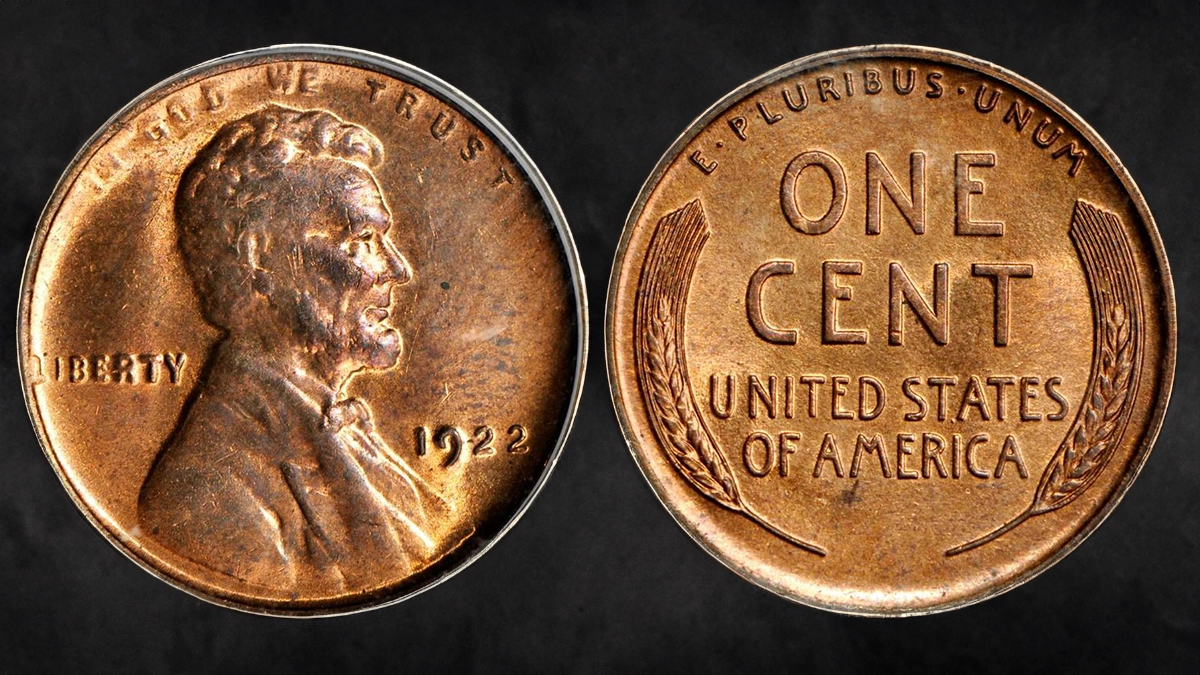
Sometimes referred to as the 1922 “Plain” or “Plain D” Lincoln Cent, the 1922 “No D” Lincoln Cent is a mint error that achieved widespread popularity after its inclusion in commercial penny boards and coin albums.
In a 1964 issue of the Empire Investors Report, author Q. David Bowers had this to say about the popularity of the “No D”: “Had pieces been struck at Philadelphia, the 1922 “plain” would be nearly worthless and would be sold only as poor examples of an otherwise common coin.”
The 1922 “No D” was struck at the Denver Mint using dies that had mintmarks in their perfect state, but due to circumstances that occurred during use, the mintmark was not present when tens of thousands of coins were struck.
In a normal year, the absence of a mintmark on coins struck at the Denver Mint would have gone unnoticed, as mintmarks were not present on cents struck at the Philadelphia Mint. In 1922, however, Denver was the only Mint facility producing one-cent coins, meaning the 1922 “No D” cent left collectors with the impression that it was something that it was not.
After years of study, leading numismatists have identified three die pairs that exhibit the Plain D feature. The most collected version, commonly referred to as the “No D, Strong Reverse”, but called Die Pair II by specialists, lost its “D” mintmark when it was polished off of the die in an attempt to repair it following a clash event (a die clash is when the obverse and reverse dies came into contact with each other when a planchet is not properly seated in the press). While removing the reverse clash images from the obverse, the “D” mintmark was effaced. Other details on the obverse were also weakened. The reverse die involved in the episode was discarded and the repaired obverse was paired with a new reverse. Die Pair II is considered the only true “No D” variety.
The other two die pairs exhibit signs of die erosion, where the “D” was gradually “ground” off of the surface of the die due to overuse. These fill the role of the “poor man’s” version of the popular 1922 “No D” and sell for less.
Top Population: PCGS MS64RD (1, 3/2025), NGC MS65+RB (1, 3/2025), and CAC MS64RD (1:0 stickered:graded, 3/2025).
- NGC MS65BN CAC #25057287: Heritage Auctions, April 25, 2013, Lot 4137 – $82,250; Heritage Auctions, August 7, 2014, Lot 5534 – $67,562.50.
- PCGS MS64RB CAC #40278159: “The Peter Sharrer Collection,” Heritage Auctions, January 11, 2024, Lot 4027 – $72,000.
- PCGS MS64RB #10004906: “The Bill Dailey Collection,” Heritage Auctions, January 2002, Lot 5703 – $38,525; “The Jerald L. Martin Collection,” Heritage Auctions, January 10, 2019, Lot 4355 – $42,000. Jerald L. Martin Collection on insert. Two deep, nearly touching diagonal hits on the back of Lincoln’s jaw. Red is mostly mellowed out. Diagonal hit under E of E PLURIBUS.
- PCGS MS64RB CAC #50059731: “The ESM Collection,” Stack’s Bowers, March 22, 2018, Lot 2043 – $63,000.
- NGC MS64RB #3041688-001: Heritage Auctions, May 29, 2008, Lot 1059- $74,750; Heritage Auctions, June 3, 2010, Lot 134 – $37,375.
- NGC MS64RB: “The Franklinton Collection, Part II,” Stack’s, January 7, 2008, Lot 167 – $92,000.
- PCGS MS64RB #60159576: “The Tom Mershon Collection, #2 All-Time Registry Collection of Lincoln Wheat Cents,” Heritage Auctions, May 4, 2005, Lot 5340 – $59,800.
* * *
Design
Obverse:
Litvak-American artist Victor David Brenner’s portrait of Abraham Lincoln depicts the president from the shoulder up. Lincoln is dressed in a period suit and is wearing a bow tie. Brenner’s initials V.D.B. appear in Lincoln’s shoulder truncation. At the top of the design wrapping around the rim is the motto IN GOD WE TRUST. The word LIBERTY appears behind Lincoln’s neck, on the left side of the coin. The date 1922 appears slightly lower, in front of Lincoln’s portrait, on the coin’s right side.
Below the date is the mintmark D. Or not.
Reverse:
Brenner’s “Wheat Cent” reverse. Two sheaths of wheat wrap around the right and the left side of the coin. At the top of the design, the motto E · PLURIBUS · UNUM wraps around the rim. The denomination ONE CENT is inscribed in large sans serif letters, with the bottom arm of each “E” extending beyond the arm at the top (the middle arm is recessed). Beneath the denomination, in the same font but a smaller type, is the legend UNITED STATES OF AMERICA.
Edge:
The edge of the 1922-D Lincoln Wheat Cent is plain, without reeding or edge lettering.
Designer
Victor David Brenner, born in Lithuania in 1871, immigrated to New York at the age of 19. The classically trained sculptor built a group of clients, including future president Theodore Roosevelt. Having previously created a medallion of Lincoln, Brenner was contracted by Roosevelt in 1908 to use one of his previous images of the 16th president for a new design of the cent. At the time of his death, Brenner had carved over 125 different medals, sculptures, and coins (View Designer’s Profile).
Coin Specifications
| Country: | United States of America |
| Year of Issue: | 1922 |
| Denomination: | One Cent (USD) |
| Mintmark: | D (Denver) |
| Mintage: | 7,160,000 |
| Alloy: | .950 copper, .050 tin and zinc |
| Weight: | 3.11 g |
| Diameter: | 19.00 mm |
| Edge: | Plain |
| OBV Designer: | Victor David Brenner |
| REV Designer: | Victor David Brenner |
| Quality: | Business Strike |