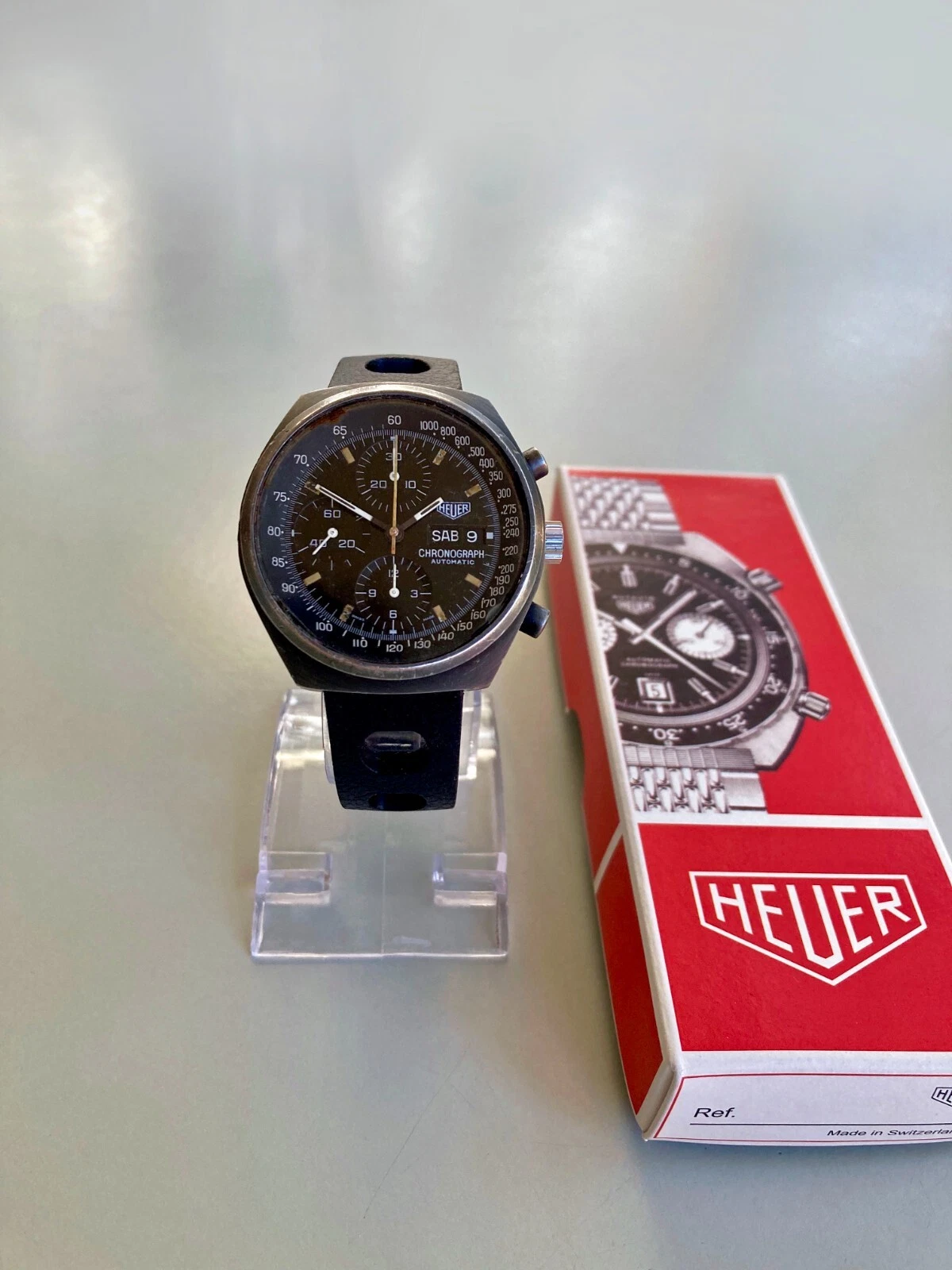
In the early 1970s, the combination of three factors led to the development of an entirely new style of chronograph. These three elements are the development of black-coatings for cases, the creation of a new style of chronograph patterned after dashboard instruments of sports cars, and the introduction of the Valjoux 7750 movement.
First, in the late 1960s, Swiss brands producing “tactical” or military style watches developed processes to coat stainless steel watches with black material. The black-coated watches were thick, slab-like chunks of steel, coated with a durable black material, with the traditional lugs yielding to the solid top and bottom surfaces of the case, with the strap or bracelet attaching underneath these surfaces.
Second, in the early 1970s, brands developed a style heavily inspired by sports car instrumentation: the dials were solid black, with white paint for the minutes, seconds and chronograph registers and painted luminous markers for the hours.
Third, with the introduction of the Valjoux 7750 movement, which used a 6-9-12 arrangement for the three registers, with chronograph minutes at 12 o’clock, chronograph hours at 6 o’clock, and running seconds at 9 o’clock. Traditional chronograph from the 1960s had positioned the three registers across the center and bottom of the dial, in the 3-6-9 o’clock positions.
Heuer took an incremental approach in developing black-coated chronographs in the 1970s. First came the Monza, in 1976, which was basically a black-coated version of the Carrera case that had been introduced in 1969. With the success of the Monza, Heuer would offer black-coated versions of several different models of its chronographs – a barrel-shaped Carrera, one of the Calibre 12 Montreal and even the radical square Monaco. But after producing black-coated versions of these four models, in 1979, Heuer took the bold step of introducing an entirely new model chronograph that would be designed from the ground up as a black-coated chronograph – the Pasadena..
Design:
The Heuer Pasadena has a large black-coated steel case with the top surface of the case having a concave finish (as if metal has been scooped out) and the case using the lug-less design common to these 1970s chronographs. While there was a stainless steel model, the best-known Pasadena is the blackened model.
Consistent with the style of instruments used on sports cars, the dial of the Pasadena is clear and simple, with legibility being the most important attribute of the design. The dial and registers are all-black, with markings of the registers and minutes and seconds in bright white, and luminous strips marking the hours. In keeping with the layout of the Valjoux 7750 movement, the sub-dials are placed at 12, 6 and 9 o’clock, with a simple date window at 3 o’clock. The hands are also typical of the time -- lume coated rectangular hour and minute hands, generally matching the hour markers, and a central chronograph second hand in bright red, with no taper at all. Even by the standards of 1970s instrument-style chronographs, the Pasadena was a large watch, measuring 41 millimeters across the dial and 45 millimeters from the top of the case to the bottom of the case, with a thickness of 14 millimeters.
Case:
Case diameter: ~41 x 45 mm
Between lugs: 19mm
Case: Steel
Dial and Crystal
Dial colour: Black
Crystal: Flat Plexi
Spanish Language Dial
Movement:
Automatic, Self Winding
Chronograph, Day & Date Complications
Condition:
Crystal: Very Good
Dial: Tropical - Speckled Patina
Hour Markers Showing Lume Degradation
Case : Various Age Related Marks / Wear
Band: Original Style Rally Strap Freshly Replaced.
Overall : Perfect everyday wearer for the fan of classic motorsport or vintage watches.
Please Refer to Photos
Package Includes:
Vintage Heuer Automatic Chronograph as Pictured
Postage:
Flat Rate International Postage: AU$79.95
All watches are checked for accurate timekeeping before postage.
Dive watches are not pressure tested unless stated.