

Home |

Contact Us |

Skype |

Facebook |

+39 055.863311 |

F427810 2CSF202001R4400 AC40A 500MA DIFFERENTIAL SWITCH 2P LIFESAVER

OTHER SWITCHES AVAILABLE: (prices in euros)F427799
2CSF202001R0160
F202 AC 16A 10MA DIFFERENTIAL SWITCH 2P
€ 94,70
F427800
2CSF202001R1250
F202 AC 25A 30MA DIFFERENTIAL SWITCH 2P
€ 54,41
F427803
2CSF202001R2250
F202 AC 25A 100MA DIFFERENTIAL SWITCH 2P
€ 75,15
F427806
2CSF202001R3250
F202 AC 25A 300MA DIFFERENTIAL SWITCH 2P
€ 68,31
F427809
2CSF202001R4250
F202 AC 25A 500MA DIFFERENTIAL SWITCH 2P
€ 68,31
F427801
2CSF202001R1400
F202 AC 40A 30MA DIFFERENTIAL SWITCH 2P
€ 85,58
F427804
2CSF202001R2400
F202 AC 40A 100MA DIFFERENTIAL SWITCH 2P
€ 90,58
F427807
2CSF202001R3400
F202 AC 40A 300MA DIFFERENTIAL SWITCH 2P
€ 82,36
F427810
2CSF202001R4400
F202 AC 40A 500MA DIFFERENTIAL SWITCH 2P
€ 82,36
F427802
2CSF202001R1630
F202 AC 63A 30MA DIFFERENTIAL SWITCH 2P
€ 123,03
F427805
2CSF202001R2630
F202 AC 63A 100MA DIFFERENTIAL SWITCH 2P
€ 131,45
F427808
2CSF202001R3630
F202 AC 63A 300MA DIFFERENTIAL SWITCH 2P
€ 119,48
F427811
2CSF202001R4630
F202 AC 63A 500MA DIFFERENTIAL SWITCH 2P
€ 119,48
DESCRIPTION:In electrical engineering, the differential switch, commonly said lifesaving making reference to the old circuit breaker, is a safety device capable of interrupting the flow of electric energy in an electric circuit of an electrical system in case of ground fault (electric leakage) or phase-to-ground lightning thus providing protection to even electric macroshock both directly and indirectly on people at risk. Do not provides any protection against overload or short circuit between phases or between phase and neutral, for which it is instead required a switch. They are widely used in commercial devices that integrate both devices (commonly called life-saving, widely used as a trade name). It is said differential because bases its operation on the detection of any difference of electric currents detected in the input and output to the electrical system in the event of leakage.
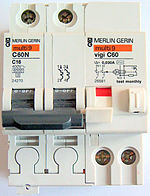
F427799 | 2CSF202001R0160 | F202 AC 16A 10MA DIFFERENTIAL SWITCH 2P | € 94,70 |
F427800 | 2CSF202001R1250 | F202 AC 25A 30MA DIFFERENTIAL SWITCH 2P | € 54,41 |
F427803 | 2CSF202001R2250 | F202 AC 25A 100MA DIFFERENTIAL SWITCH 2P | € 75,15 |
F427806 | 2CSF202001R3250 | F202 AC 25A 300MA DIFFERENTIAL SWITCH 2P | € 68,31 |
F427809 | 2CSF202001R4250 | F202 AC 25A 500MA DIFFERENTIAL SWITCH 2P | € 68,31 |
F427801 | 2CSF202001R1400 | F202 AC 40A 30MA DIFFERENTIAL SWITCH 2P | € 85,58 |
F427804 | 2CSF202001R2400 | F202 AC 40A 100MA DIFFERENTIAL SWITCH 2P | € 90,58 |
F427807 | 2CSF202001R3400 | F202 AC 40A 300MA DIFFERENTIAL SWITCH 2P | € 82,36 |
F427810 | 2CSF202001R4400 | F202 AC 40A 500MA DIFFERENTIAL SWITCH 2P | € 82,36 |
F427802 | 2CSF202001R1630 | F202 AC 63A 30MA DIFFERENTIAL SWITCH 2P | € 123,03 |
F427805 | 2CSF202001R2630 | F202 AC 63A 100MA DIFFERENTIAL SWITCH 2P | € 131,45 |
F427808 | 2CSF202001R3630 | F202 AC 63A 300MA DIFFERENTIAL SWITCH 2P | € 119,48 |
F427811 | 2CSF202001R4630 | F202 AC 63A 500MA DIFFERENTIAL SWITCH 2P | € 119,48 |
Principle of operation

Considering the circuit to be protected as a single node, it can be said that the algebraic sum of the currents in it must be zero (first principle of Kirchhoff). Therefore, if you measure the intensity of the current in a single-phase system, it will be observed that the inward current is equal to the outgoing one. In a three-phase system the sum of the currents, giving a positive sign for inflow and negative for outgoing calls, shall be void.
If the insulation of a device connected to the system fails, it is possible to create a connection that is more or less effective between the power line and the metal frame (technically defined mass), which may become the cause of electrocution if touched . If the connection is precarious is also possible that produce heat by the Joule effect with the consequent development of a fire.
Since the distribution centers of the power grid and transformer substations mt / bt (medium voltage / low voltage), the neutral point is grounded, any connection between one phase of the power line and the ground undergoes a flow of current. This current is lost to the ground and does not come back through the circuit breaker upstream of the plant, which states that the sum of the current node is no longer zero and intervenes by opening the electrical circuit. To avoid that it is a human body to build the bridge phase-to-ground and facilitate the work of the differential switch is necessary that the equipment with metal casing are connected to an appropriate earthing system. We talk, in this case, protection against indirect contacts.
Instead, in the case in which a person touches a part that is normally in tension, such as an electrical conductor not isolated, it comes to direct contact. Even in this case, the differential switch provides, in most cases, a good protection, provided that it is of the type with high sensitivity, that is, with a nominal differential current less than or equal to 30 mA, and have a response time sufficiently short (few milliseconds). It should be noted that the presence of the differential absolutely does not exempt from the requirement to prepare an earth system made in a workmanlike manner.
In case of electrical installations with multiple leads in parallel you can install more differential protection of each branch is derived, so as to realize a selective protection, ie such as to isolate only the branch concerned to the fault, without powering down the other branches. If, in addition to the protections of the individual branches, is also installed a differential protection generally common to all branches, is used usually at a differential of the delayed type, to prevent this, intervening before those located downstream, also disalimenti circuits no failures.
Structure and function


In a differential switch is a magnetic circuit (in practice, a current transformer) on which are wound solenoids (one for each thread to be protected) so that in conditions of equilibrium, the magnetic flux produced is canceled mutually. In case of imbalance, the magnetic flux is no longer null and is sufficient to attract a brake anchor, which causes the tripping of a spring which opens the switch.
In some models, the contacts are kept normally closed by an electromagnet powered by an electronic circuit. When one is detected-balance of the current measured by another solenoid, the circuit cuts off the power to the electromagnet and causes the opening of contacts.
To ensure continuity of operation is required in carrying out a test on a monthly basis, by pressing a button on the appliance.
Plants
Since a real system has inevitably small imbalances due to dispersion and also because there are minimum limits of sensitivity practically achievable, but at the same time to ensure an adequate level of protection in the event of electric shock, are precisely defined thresholds.
Areas
For installations in residential buildings the maximum allowable difference current, denoted by the Greek letter Δ, must be less than or equal to 30 milliamps.
In industrial and commercial use differential Δ is less than or equal to 300 milliamps, but having response times lower than the corresponding civil.
Disposition
Under civil differentials were used in a centralized way, so with a single differential controlled the entire house. With the entry into force (September 2011) of Annex A of IEC 64-8 V3, even in domestic systems is required the use of at least two circuit breakers in order to ensure greater security and better continuity of service .
In the industrial plants are divided into zones in order to achieve a selective protection, so that a failure in one area causes the intervention of the differential only to protection of the zone itself, without involving the entire plant.
To do this, you use multiple circuit breakers with different values of delta and different response times (differential delay).
Type of current
There are also different classes of circuit breakers which are distinguished by the type of fault current which are sensitive:
AC: they are only sensitive to the sinusoidal alternating current (marked with a drawing of a wave).
A: are also sensitive to unidirectional pulsating currents.
F: are also sensitive to leakage currents with frequency ranging from 10Hz to 1kHz, necessary to protect electronic loads or single-phase inverters.
B: Responding to losses in DC, where necessary three-phase frequency converters are used.
IT IS RECOMMENDED THAT THE SHIPPING TRACEABLE is MORE 'SAFE, DO NOT RESPOND OTHERWISE FOR ANY LOSS OR DELAYS.
There are also different classes of circuit breakers which are distinguished by the type of fault current which are sensitive:
AC: they are only sensitive to the sinusoidal alternating current (marked with a drawing of a wave).
A: are also sensitive to unidirectional pulsating currents.
F: are also sensitive to leakage currents with frequency ranging from 10Hz to 1kHz, necessary to protect electronic loads or single-phase inverters.
B: Responding to losses in DC, where necessary three-phase frequency converters are used.


The shipping costs are always real, based on the lists of our couriers and are calculated according to the:
- weight / volume ratio
Despatch goods:
Delivery:
we inform our customers that the shipping is by means:
- SDA OR THROUGH POSTAL

Fatturazione:

Before you ask us to send back the 'exact address to which to send back the' object !!

Responsible for processing the data: ErreBi cablaggi s.r.l.

For any inconvenience or misunderstanding happens during the transaction please contact us IMMEDIATELY, our commitment will be 'total to make sure to bring a happy ending sale
